

Abstract
Is our sense of space something we learn, or something that we are born with? The MEC is a central hub of the mammalian navigation system, containing spatially and directionally tuned neurons, including grid cells and head-direction cells, which encode an animal's position and orientation. At the population level these cells form internal maps with periodic topologies: head-direction cells traverse ring-like manifolds, while grid cells are organised on toroidal manifolds. These attractor-like networks enable the storage and update of continuous variables, but their developmental timeline remains unknown.
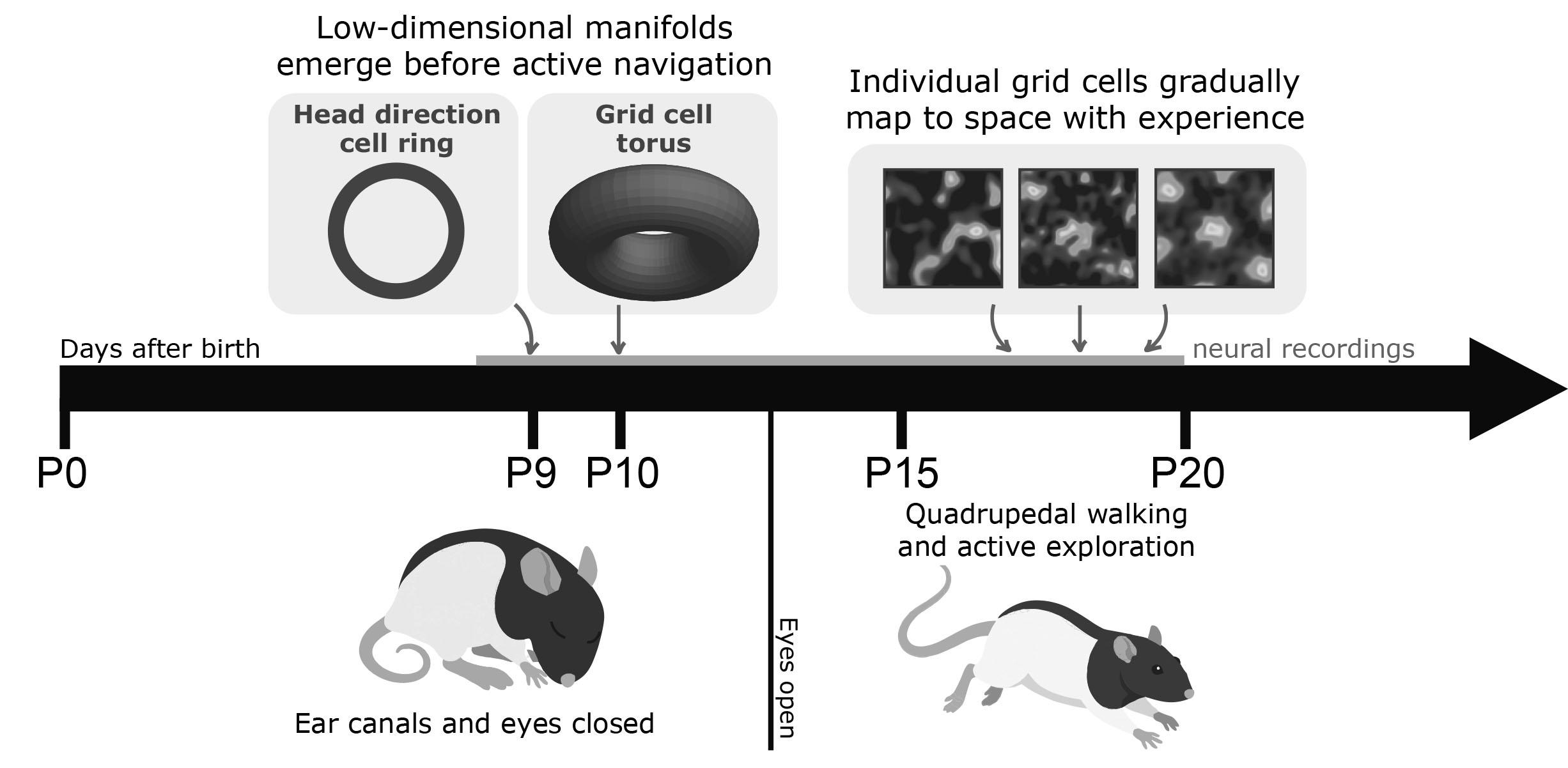
Using Neuropixels 2.0, we obtained large-scale ensemble recordings in sleeping rat pups, capturing up to ~1,000 simultaneous units in the MEC as early as postnatal day 8 (P8). We discovered that toroidal manifolds emerge as early as P10, preceding eye and ear opening, quadrupedal gait and active exploration. These toroidal manifolds were modular from the beginning, with multiple tori simultaneously identified along the dorsoventral axis of the MEC. Their abrupt emergence aligned with a desynchronisation of entorhinal population dynamics, which in turn coincided with an increase in inhibitory drive within the network, enabling the entorhinal cortex to disengage from external sensory inputs. Similarly, we detected clusters with HD ring-like topology as early as P9 in the parasubiculum (PaS), a major input region to the MEC. The movement dynamics of tori and rings were coordinated as soon as they were recorded simultaneously (P10). In a second set of experiments, we carried out chronic recordings in pups from P15 onward. As pups began to explore open-field arenas, the internally generated maps gradually aligned with external landmarks, culminating in stable spatial firing fields by three weeks of age. These results support the idea that even complex cognitive operations, such as spatial navigation, rely on preconfigured networks which subsequently anchor to the external world through experience-dependent plasticity.
Biography
Matteo is a systems neuroscientist and physiologist interested in how sensory, motor, and cognitive networks coordinate during development to give rise to increasingly adaptive behaviour. He currently works on the ontogeny of the spatial navigation system in the entorhinal cortex, combining large-scale in vivo electrophysiology in developing rodents with topological data analysis of neural population dynamics.
He is a Solberg Postdoctoral Fellow with Edvard and May-Britt Moser at the Kavli Institute for Systems Neuroscience (NTNU), and works closely with Benjamin Dunn (NTNU). He did his PhD at the Donders Institute (NL) studying temporal coding in the hippocampus, with Francesco Battaglia and Federico Stella.