

Abstract
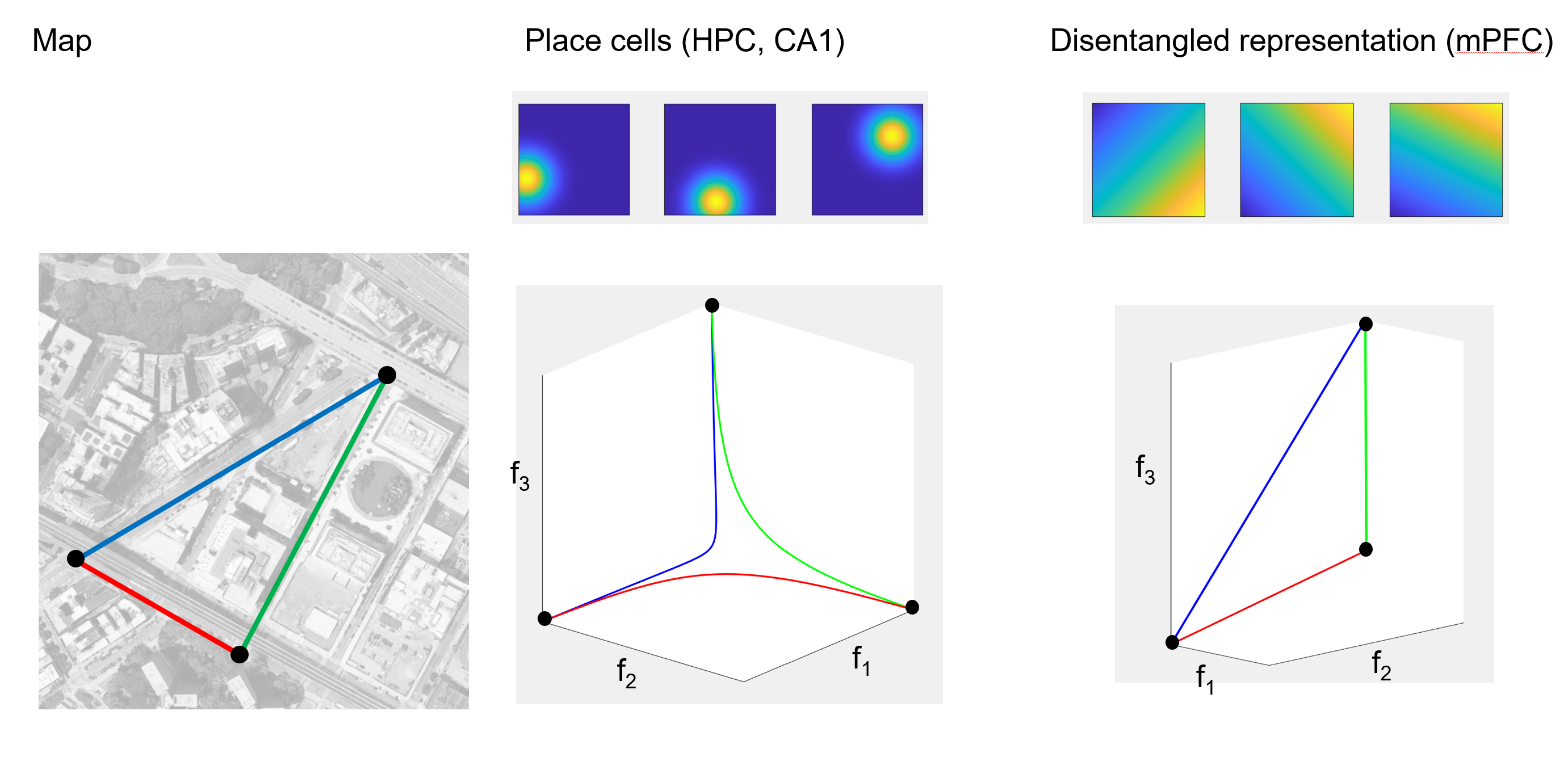
We recently observed disentangled abstract neural geometries in multiple areas and across different species. In these representations, different variables are encoded in approximately orthogonal subspaces, facilitating generalization in novel situations. In collaboration with the Axel and Abbott groups (data collected by Rajyashree Sen), we observed a spatial representation in medial prefrontal cortex (mPFC) that extrapolates from explored to unexplored regions of space. Using GCaMP6f imaging in miniscope-implanted mice, we recorded excitatory neurons in the dorso-medial prefrontal cortex (mPFC), hippocampal dorsal CA1 (dCA1), as mice freely explored a square arena. Position could be decoded with high accuracy from both mPFC and dCA1 populations, with the hippocampus showing the highest overall decoding accuracy. In mPFC, a linear regressor trained to predict the animal’s x-position in one half of the arena accurately generalized to the opposite half. Similarly, for the y-position. This indicates a linear, disentangled, map-like representation of space that might support generalization. In contrast, the dCA1 showed markedly reduced generalization, consistent with a localized place-cell code. The distances in the physical space are better preserved in the neural activity space in mPFC, and the dimensionality of the subspace encoding position is higher in dCA1. The mPFC representations are a real map of the environment, and they are well-suited for navigation.
Biography
Stefano Fusi was born in Florence, Italy, and graduated in 1992 from the Sapienza University of Rome with a degree in physics. After his degree, he obtained a researcher position at the Italian National Institute for Nuclear Physics in Rome and started to work in the field of theoretical neuroscience. In 1999, he received a Ph.D. in physics from the Hebrew University of Jerusalem, Israel, and moved to the University of Bern, Switzerland, as a postdoctoral fellow. After visiting Brandeis University as a postdoctoral fellow in 2003, in 2005 he was awarded a professorial fellowship by the Swiss National Science Foundation and became an assistant professor at the Swiss Federal Institute of Technology in Zurich (ETHZ), Switzerland. In 2009, he joined the Department of Neuroscience at Columbia University as an associate professor. He is an associate editor of Frontiers in Computational Neuroscience and the Journal of Computational Neuroscience. Fusi’s research involves the computational modeling and theoretical analysis of complex neural circuits with the goal of understanding the role of biological complexity and diversity in the nervous system. His laboratory collaborates with experimental neuroscientists at Columbia University, the Massachusetts Institute of Technology and Stanford University.