

Abstract
Hierarchical networks are fundamental features of the mammalian visual system, but how such networks are both constructed during development and used for reliable computation remains unclear. Recent our studies suggest that intrinsic neural activity plays key roles in both processes.
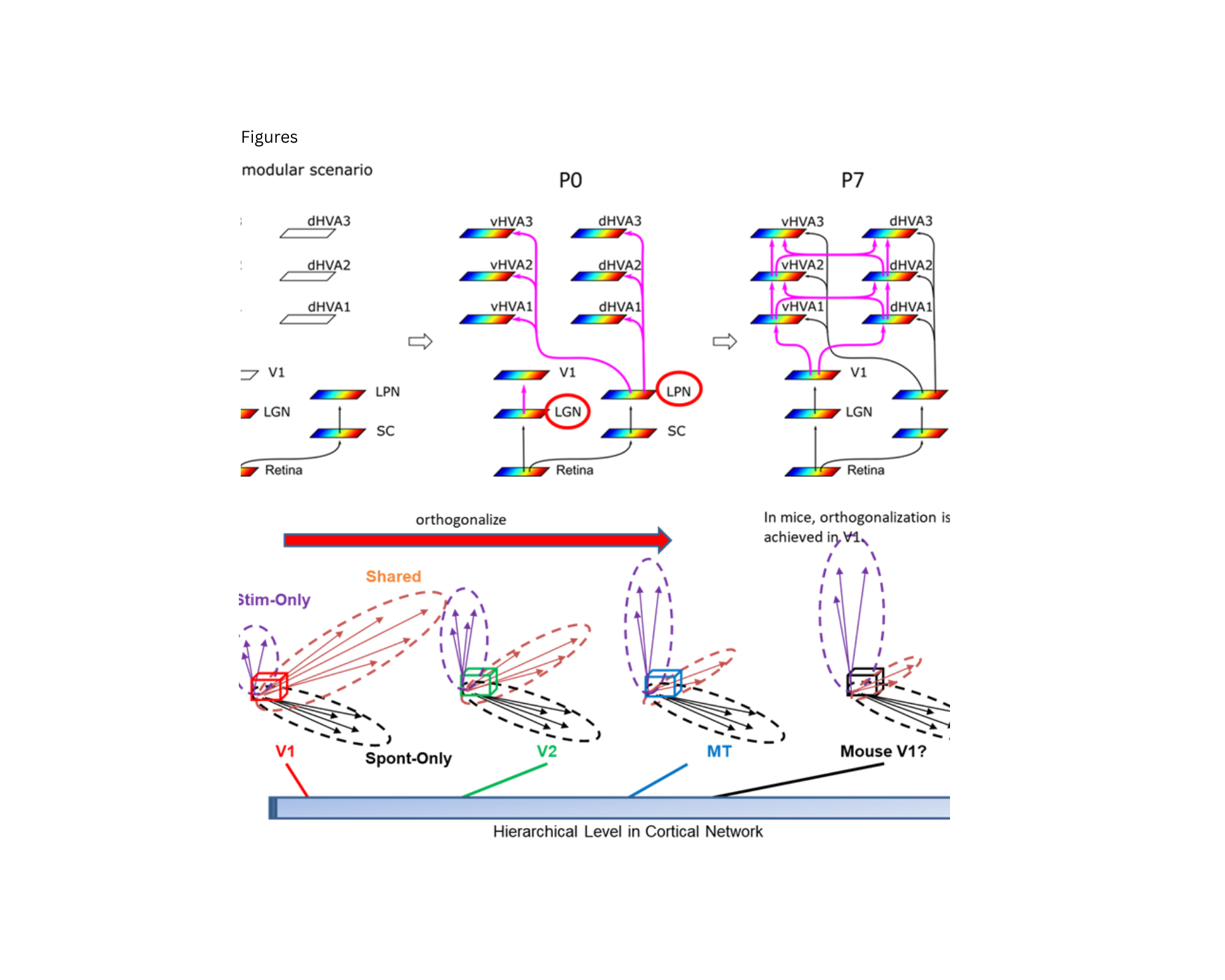
During development, the visual network is not formed strictly in a step-by-step hierarchical sequence. Instead, parallel modules linking the retina, thalamus, and multiple visual cortical areas first emerge. In mice, pathways from the retina to primary visual cortex (V1) and higher visual areas are established through lower- and higher-order thalamic nuclei before corticocortical connections appear. These modules are later linked by corticocortical connections to form a hierarchical cortical network. Retina-driven intrinsic activity contributes to establishing retinotopic organization across these modules (Murakami et al., 2022).
Intrinsic activity also shapes computation in the mature cortex. In primates, intrinsic and stimulus-evoked activity patterns are similar in V1, but become progressively orthogonal in higher visual areas along the cortical hierarchy. This transformation separates sensory signals from ongoing internal activity (Matsui et al., 2024).
Together, these findings suggest that intrinsic activity contributes both to the assembly of hierarchical cortical networks during development and to the reliable processing of sensory information in the mature brain.
Professor Kenichi Ohki is interested in visual neuroscience and functional brain mapping. In 2005, he developed a method of single-cell resolution functional mapping with two-photon calcium imaging, and was able to measure the orientation selectivity of hundreds of neurons in visual cortex revealing the functional architecture of visual cortex between rodents and higher mammals (Ohki et al., 2005, Nature). In 2006, using this method, he solved a long-standing problem in visual neuroscience - the micro-architecture of pinwheel centers at the single-cell level (Ohki et al., 2006). In 2012, he found that neurons derived from the same neural stem cells tend to acquire similar orientation selectivity in the adult mouse visual cortex (Ohtsuki et al., 2012) and later that neuronal activity is not required for the initial formation of orientation selectivity, but required for the later reorganization (Hagihara et al., 2015). His lab continues to study the interplay between innate circuits determined by the developmental programs, and neuronal activity in determining the functions of neurons in the cerebral cortex.