

Abstract:
Our ability to sequence movements and actions in response to unpredictable environmental events underlies our rich and adaptive behavioural repertoire. Such flexible behaviours contrast with overtrained, or automatic, motor sequences directed at specific tasks and executed the same way every time. We probed how neural circuits underlie these distinct forms of motor sequence execution by training rats on a 'piano task', in which the same motor sequence can be generated in response to unpredictable cues or overtrained to the point of automaticity. By measuring and manipulating neural activity in motor cortex and sensorimotor striatum, we delineate the logic by which these circuits combine to generate both flexible and automatic motor sequences.
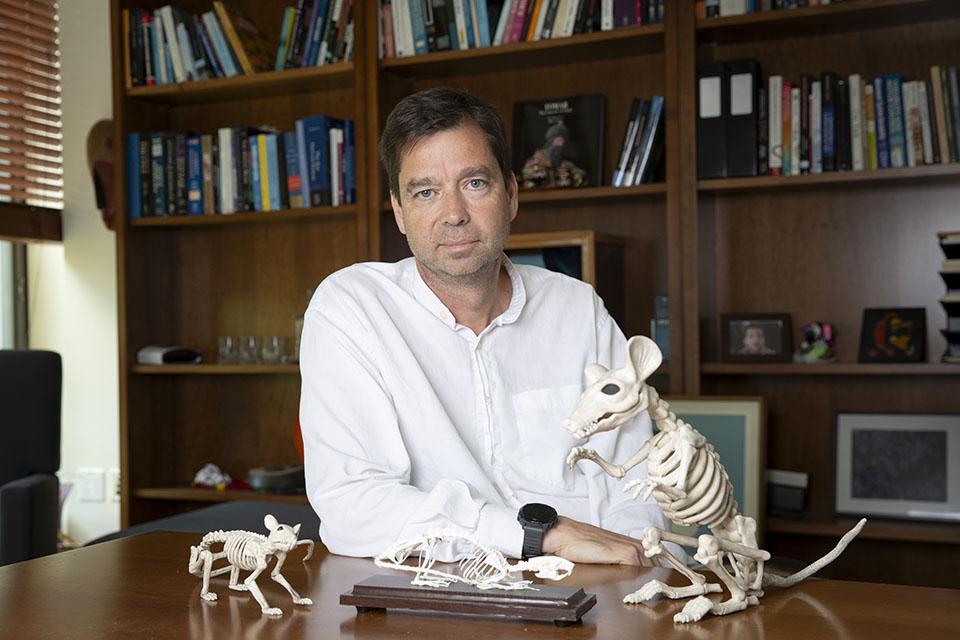
Biography
Bence Ölveczky is a professor in the Department of Organismic and Evolutionary Biology at Harvard University. A mechanical engineer by training, Ölveczky earned his Ph.D. in neuroscience from Harvard University working with Markus Meister on motion processing in the retina. As a junior fellow in the Harvard Society of Fellows, Ölveczky worked with Michale Fee at the Massachusetts Institute of Technology on the neural mechanisms of vocal learning in songbirds.
The Ölveczky lab is interested in how motor skills are learned and generated by the brain. They study this in rodents, generalist motor learners with the capacity to master a variety of different tasks. The lab has developed a unique experimental infrastructure to address these questions, including a fully automated high-throughput training system for rodents that can be combined with continuous long-term neural and behavioral recordings. They use this together with sophisticated circuit dissection tools to arrive at mechanistic descriptions of how the mammalian brain learns and executes motor skills.