Predicting the future or remembering the past?
21 October 2026
Dr Farzaneh Najafi studies how the brain predicts what is about to happen, and how, when those predictions go awry, they may lead to hallucinations or conditions like schizophrenia.
At a recent SWC Seminar, the Georgia Tech neuroscientist discussed her work that tackles a specific question about how the brain makes predictions. When neurons in the visual cortex ramp their activity up or down between repeated events, are they predicting when the next event will arrive, or registering how much time has passed since the last one?
The two processes look similar in most experiments, and, as they happen at the same time, they are easy to conflate. Studying mice that passively watched a repeating flash and tone, Dr Najafi designed experiments to tell them apart. She concluded that what looked like prediction was, in this setting, something else: activity settling toward baseline after each stimulus. And this signal carries information about elapsed time.
In this Q&A, she discusses her work and where it leaves the wider idea that the brain is, at its core, a prediction machine.
Can you introduce the questions you are trying to answer about how the brain works?
In neuroscience, a huge area of study is how the brain actively predicts the world. These predictions help with faster reaction times and adaptation.
If the brain was entirely using feedback mechanisms—meaning that we do some action, wait for feedback, and then correct our action—we would not be able to adapt fast enough to survive.
Predictive processing is a very interesting framework. But it's been controversial because some people believe that the experimental evidence for it is weak. For example, the neurons with a prediction or prediction error response could be a very small percentage of neurons or their response magnitude may be quite small.
As a neuroscientist, I want to find the evidence for it.
Can you tell us about your results – what signals did you find?
Many people have assumed that the gradually building or fading patterns of brain activity that we see between repeated events mean the brain is predicting what's coming next. But whether they reflect predictions or instead emerge from sensory mechanisms has been unclear.
To find out, we used two-photon calcium imaging across multiple cell types in visual and parietal cortex, while mice passively received repeated visual and auditory stimuli. The gaps between the stimuli were structured in different ways.
Neurons segregated into two broad response classes. Some switched on with each stimulus and then faded (we're calling these ramp-down). Others did the opposite, building up as the next stimulus approached (ramp-up). Within each group, individual neurons had their own dynamics.
Multiple findings argued against these being predictive signals. First, ramping activity was present in animals that had never seen or heard the stimulus before. So, it wasn’t something they had learned. Also, neural responses did not depend on how predictable the timing of the next stimulus was; in other words, same neural responses were observed whether stimulus intervals were fixed or jittered.
Looking at the neurons as a whole population, they represented not what the brain was gearing up for, but instead more like it settling back down after what just happened. And the information within that population carried a robust signal for elapsed time.
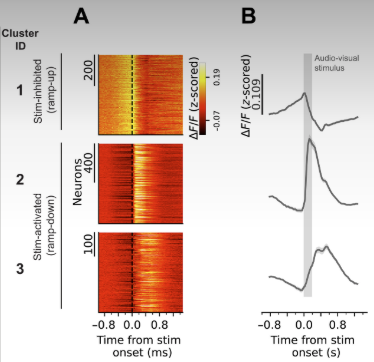
Data from random sessions show that all neural clusters are present in naïve mice and do not require extensive learning to emerge. Each row corresponds to a cluster: 1= ramp up neurons, 2 & 3 = ramp down neurons. (A) Heatmaps of trial-averaged, single-neuron activity aligned on stimulus onset (black dashed line) for each cluster. (B) Neuron- and trial-averaged responses aligned on the stimulus (gray box) for each cluster.
Is that a claim that these neurons never do prediction, or that your experiments find no evidence of it under these passive conditions?
It is important to avoid overreading a result, so we were very specific with the interpretation. This is exactly why we chose a long title for our paper, even though I don’t generally like long paper titles.
Things might be very different if the mice were doing active perception or movements, or even under different passive paradigms where sensory inputs are a function of movements, like in the real world.
So yes, I think that this could be different under a different behavioural paradigm. That's why we're studying a range of behaviours, not to be misled by just one.
Do you have any evidence that the mouse brain uses the timing information?
With this passive paradigm, we don't know.
The easiest way to find out if the mouse uses the information is to have the mouse do a task. We do have a version of this behaviour now that we show the exact same stimuli with different intervals, and the mouse has to attend to intervals and make a time-based judgment. For example, was this a short interval or a long interval? We don’t have the results yet - that's a project to come.
You’ve worked on predictive processing in the past. What was it like to find results that challenged what you’d seen before?
We got these results a few months after starting the experiment. And it's very hard when you find something that is not aligned with the hypothesis that you started with. Hard and also a little bit scary because it feels like ‘how am I going to make sense of these data’?
But the beauty of science is that intellectual challenge. First of all, you want to make sure things are right. So that's why we came up with different experiments that addressed the same question from different angles.
At that point, I go to the whiteboard, lay out all the analysis results, and start mind mapping— drawing connections between different findings to see how they fit together. By doing this, it was clear that neural ramps were all about stimulus inhibition and recovery. They were not about expectation signals.
You also always find out new questions that the existing data cannot answer. At that point, you have to design new experiments. There are always more open questions than answers.
The beauty of science is that, at the end of the day, we can make better sense of the data.
I think for me, as a scientist, it's really, really important to keep my mind open so I allow myself to see results that are contrary to the mainstream hypothesis.
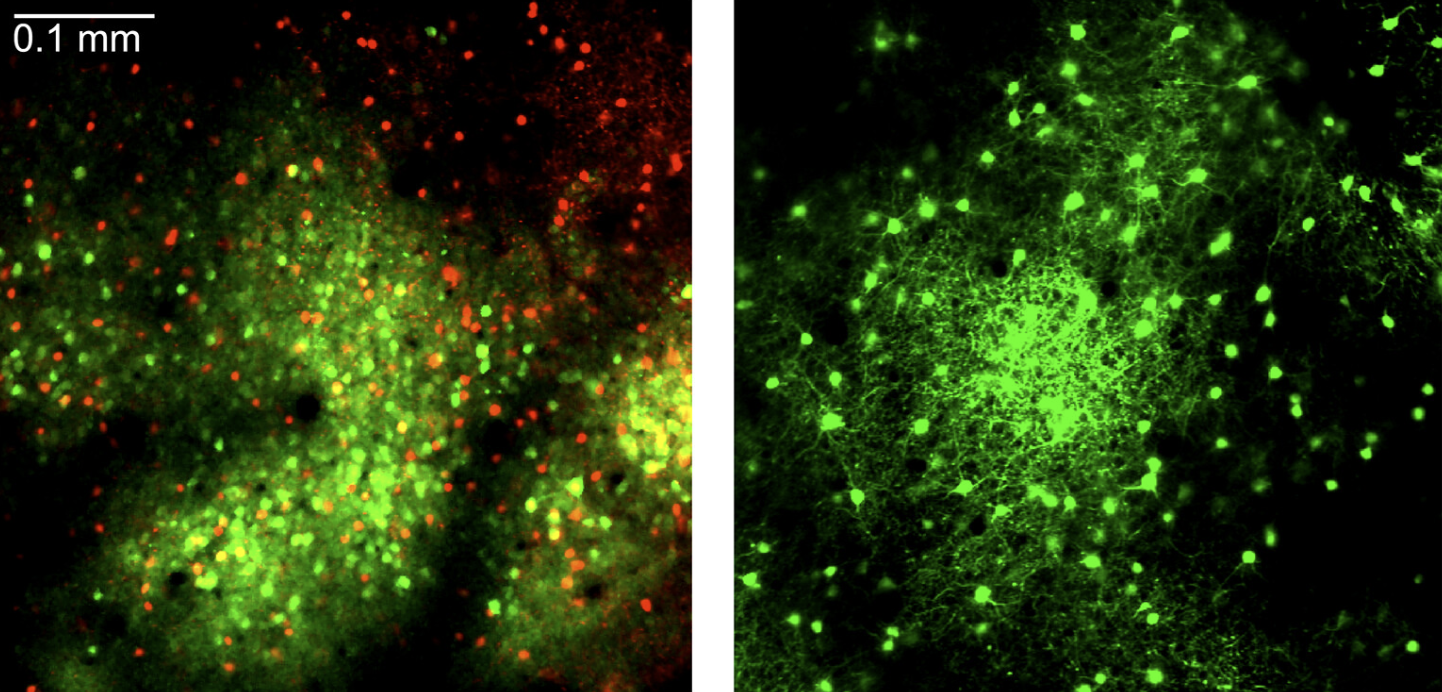
Imaging field of view from two example sessions, visual cortex. Left: VIP interneurons are labelled red/yellow and non-VIP neurons green. Right: SST interneurons are green.
One interesting finding you discussed was that a proportion of these ramp-up neurons with the stimulus-inhibited response rose across days of experiment. How do you distinguish that from that being the brain learning over time?
This is a very interesting question. We did observe more stimulus-inhibited neurons over days, but as I mentioned earlier this increase was not about learning the timing of the upcoming stimuli. I would love to know the mechanisms that lead to this increase in stimulus-inhibited neurons, and the significance of it.
Regarding your question, one thing to think about is what we define as learning. If we define learning as any change, then this is learning. There is some change at the circuit level that leads to more inhibition than excitation. One hypothesis is that thalamo-cortical circuits recruit more inhibitory neurons in response to a stimulus.
In addition to the mechanism, you might ask what’s the significance of this? Why would the brain want to become more inhibitory than excitatory over time?
I don't have an answer for these questions, but these are among the most exciting questions that we’ve got at the end of this project that I would love to follow up on.
How does your work fit into what we know about how the brain keeps track of short stretches of time?
There are different theories of how the brain keeps track of time. The old-school theory is that there's a certain brain area that acts like an internal clock, dedicated to keeping track of time.
That was a popular idea until evidence came out that even in a dish, there are population dynamics in brain tissue that can be used to decode time. This suggested that time coding is an intrinsic mechanism of neural circuits and doesn’t need dedicated circuits. This has now become the more dominant theory in the field for how the brain represents time.
Our findings also provide strong evidence for this hypothesis. We found different neurons responded with distinct temporal profiles to a stimulus. Some had fast rise and decay. Some other neurons had slow rise and decay. With different response dynamics to the same stimulus, together, neurons can encode time.
If the visual cortex isn't where visual timing predictions live, do you think they are somewhere else?
I think the human brain has the mechanism to detect temporal order and misorder even when we are not instructed to attend to them. If there's some regular input around you, like repeating flashes of light, once the rhythm is violated, you will notice.
Maybe this is different for the mouse - but before getting there, I really want to see what the other brain regions, like the cerebellum and hippocampus, might be doing. We have started with the cerebellum.
What do you hope people will take from your research?
The most important insight is that different mechanisms can lead to the same phenomenon. We tend to initially think of the mechanism that confirms our hypothesis; but it's so important to be aware that there are different mechanisms that can lead to the same outcome, and try to parse those out.
And this goes beyond just science.

Biography
Dr. Farzaneh Najafi studied Biotechnology at the University of Tehran.
She completed her PhD at the University of Pennsylvania, where she investigated cerebellar mechanisms underlying motor adaptation under the supervision of Dr. Javier Medina, in collaboration with Dr. Sam Wang at Princeton University.
She conducted her postdoctoral research at Cold Spring Harbor Laboratory, investigating parietal cortex circuits underlying decision-making behaviour under the supervision of Dr. Anne Churchland.
She then joined the Allen Institute for Brain Science, where she studied neural circuits underlying visually guided behaviour in the teams supervised by Dr. Shawn Olsen and Dr. Jerome Lecoq.
In 2023, she started her laboratory in the School of Biological Sciences at Georgia Tech, where her research focuses on the neural circuits and computations underlying predictive processing, with an emphasis on cortico-cerebellar interactions.
Her research has been recognized with multiple awards, including support from the Whitehall Foundation, Curci Foundation, Brain & Behaviour Research Foundation, Chan Zuckerberg Initiative, and Research Corporation for Science Advancement. She has also received Georgia Tech's Outstanding Undergraduate Research Mentor Award.