Smarter wiring: How dendrites make neurons more efficient
7 September 2026
For a long time, dendrites were treated as passive wiring, collecting signals, sending them on towards the cell body of a neuron for it to compute. But over the last 20 years, that picture has changed. In the late 1990’s, researchers found that dendrites could process information in more complicated ways, making them much more than passive summing devices.
Dendrites are now appreciated for their computational power – inputs arriving at dendrites have been found to have more weight if they arrive closer together in time or space, for example, meaning a change in a neuron's input does not always produce a proportional change in its output.
Dr Panayiota Poirazi, Research Director at IMBB, has been a key part of this shift in understanding. In a recent SWC seminar, she presented her latest findings. She first discussed how dendrites assist the formation of the place cells that help us navigate. She also presented her work showing how hotspots of synaptic inputs on dendrites can help animals learn flexible behaviours. In this Q&A, she introduces her research and how dendrites make the brain more efficient.
You’ve shown that the dendritic inputs, the spines, on a place cell are clustered, and that this formation makes cells more efficient. Can you tell us about that finding?
Our modelling shows that if a cell exploits dendritic nonlinearities fully, it could achieve the same results using fewer synapses and therefore fewer resources. By just increasing the number of synapses uniformly across a cell, or increasing their strength, you might get the same output, but the nonlinearities are not capitalised on. If you have a neuron with multiple such clusters, and clusters allow the neuron to be tuned to different locations, then a single neuron can express many more locations than if you didn't have them¹.
We also show that you can gate this through inhibition, through learning, and this increases the capacity of the brain by having neurons that are multi-tuned.
What does your work tell us more broadly about efficiency in neurons and in the brain?
We know that the brain has a limited size. It has to fit inside the skull. And it also runs on a very small amount of energy. It burns approximately 20 watts, like a small light bulb. So under these evolutionary constraints for energy and space, it had to come up with solutions that are as efficient as possible. Our modelling work on synapse clustering within hippocampal dendrites points to that direction as it suggests that neurons have come up with strategies that allow them to solve the same problem using fewer resources.
In our latest experimental findings, we also showed that spine turnover dynamics - gain, loss and clustering - are co-localised within dendritic hotspots during learning in layer 5 pyramidal neurons in the frontal cortex. This work provides complementary experimental evidence supporting the same claim. Namely that neurons re-use these dendritic hotspots to allow adaptation to new learning tasks while minimizing the use of available resources.
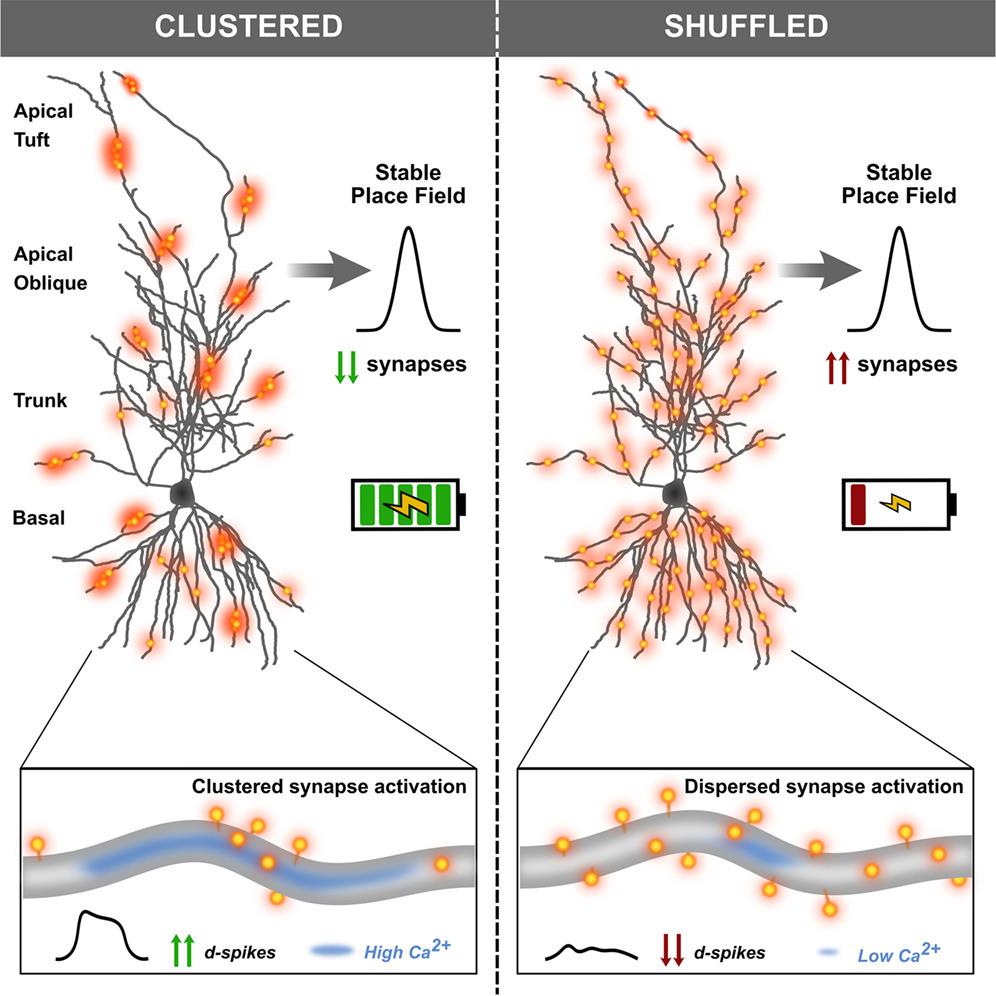
Graphical representation of clustered inputs in CA1 pyramidal neurons. Credit: Dr Panayiota Poirazi / Cell Reports.
You described this experiment during your talk, and showed us that when mice learned a new rule during a task, older dendritic inputs tended to disappear before newer ones. Does that suggest that successful learning depends on forgetting as much as acquiring the new information?
I think it depends on the kind of learning. In this particular case, there were conflicting cues during the task. In the first rule, an animal had to associate the sound with a specific location to get a reward. In the second rule, an animal then had to associate the light with a reward and ignore the sound. In this case, namely when there is competition between tasks, I think the animal has to eliminate the prior association because it's no longer valid. It's no longer rewarding.
This would not be the case with other kinds of learning. You don't necessarily have to forget something to learn something new.
Your model predicts that an old memory might disappear at the level of a whole neuron, but it would still leave a trace in individual dendrites. How does that affect how we think about where memories are stored?
We know that memories are stored in the synaptic trails in dendrites. We may study them mostly based on the activity that they produce at the cell bodies, but they are stored at the synaptic level.
I think what we need to understand is that not seeing a memory at the neuronal level doesn't mean it does not exist. That's what our model predicts - it's there. You could describe it as silent, because it doesn't drive activity at the cell body. But if it needs to, it could be readily restored because it doesn't have to be reinstated from the ground up completely. There is some trace left there in the dendrites.
Which prediction from your computational models are you most excited to test next, experimentally?
I am most excited to see what happens in our task if the animals have to switch back to the first rule and re-learn that a sound links to a reward. Will this elimination of spines that we've seen continue? And to what extent? Because now, the prior association becomes relevant again.
Would the animals use the same strategy as they used before, or would they choose a different one?
Do they still use the same dendritic hotspots as we found experimentally, or do they now push the two rules into completely separate branches so that they don't interfere with one another?
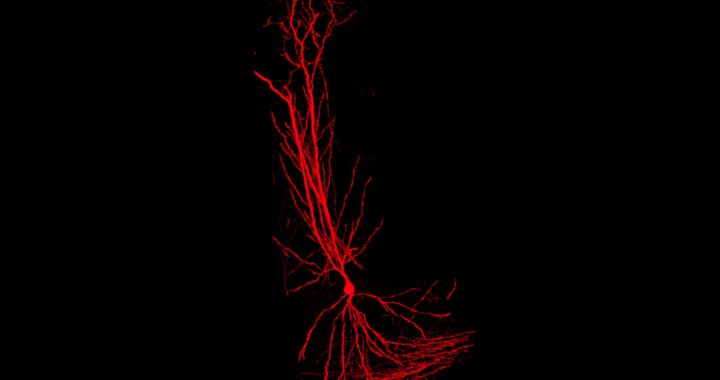
Single-synapse resolution image of a CA1 pyramidal neuron. Credit: Dr Panayiota Poirazi / Cell Reports.
How does moving between computational modelling, experiments and machine learning help you approach these kinds of questions?
I think it's really nice to do some cross-disciplinary work because it makes you think of what the impact of our experimental research could be on something that is more applied, like machine learning.
It also makes us think differently. We want to figure out what the actual benefits are that dendrites could provide to a brain, whether this is biological or artificial.
Each approach brings a completely different point of view, a different set of questions that we want to ask. I find it fascinating. I'm a mathematician by training and I really enjoy doing this cross-disciplinary work.
Your dendrite-inspired artificial neural network could solve problems with fewer parameters than conventional networks – how important is that for modern AI?
I think that modern AI, until now, didn't really care about efficiency. The major approach was to build more powerful models. But now we're starting to realise that these powerful models are burning the energy needed to light up a city. We're seeing the consequences in the environment. I think we will turn to the brain to find more efficient solutions, and dendrites are showing the way, in my view, towards finding that.
What do you think the biggest unanswered questions about dendrites are?
What I would like to know is whether there is some complex function that a brain cannot solve without dendrites. What would that be? We don't know; we haven't seen any evidence of this. So far, no computational problem cannot be solved with point neurons, assuming you have enough of them. The main differences right now are in the numbers rather than in the quality of the problem solved. And I would love to see someone proving the opposite.

Biography
Panayiota (Yiota) Poirazi is a Research Director and head of the Dendrites Lab at the Institute of Molecular Biology and Biotechnology (IMBB) of the Foundation for Research and Technology - Hellas (FORTH) in Heraklion, Crete. Her area of research covers Computational and Experimental Neuroscience and Bioinspired Machine Learning, focusing on how dendrites contribute to neuronal computations and underlie complex brain functions. She is a senior editor at eLife and Neuroscience, a member of ELLIS, EMBO and the Bernstein Network and is currently the Secretary General of FENS (Federation of European Neuroscience Societies). She is a recipient of many awards, including an Einstein Foundation fellowship, the Wilhelm Bessel Research Award, an ERC StG and the SNF-HFRI Theodoros Papazoglou award for securing an “A” in the 2023 ERC AdG call. She is the founder of the EMBO Workshop on Dendrites that takes place biennualy in Crete since 2016.