Teacher and performer: how the brain learns a skill then lets it run
11 November 2026
Unlike the date of your cousin’s birthday, you are unlikely to forget how to ride a bike. Or how to play a piece of music you learn on the piano. Once a skill like this has been acquired, doing it over and over again becomes something automatic, something we don’t need to think about. Our mind becomes free to wander while we perform.
Professor Bence Ölveczky, from Harvard University, studies this type of procedural memory in rats. An accidental finding ten years ago led him to an astonishing discovery – that, unlike the textbooks assumed, the brain’s motor cortex is not needed to perform a learned movement skill.
This set his lab on a path to uncover how the brain does learn and then perform a movement-based task. Working with rats trained on a ‘piano’ task where they have to press small levers in a specific order, he has uncovered that while the motor cortex is essential for learning a skill, it is not required to perform it. The motor cortex ‘teaches’ lower-level circuits in the striatum, which then consolidate this action sequence. But if a stereotyped learned skill is practiced together with a skill that requires flexible reuse of some of the same elements that make up the automatised behaviour, it once again becomes dependent on the cortex.
Professor Ölveczky described his findings at a recent SWC Seminar, and in this Q&A he introduces his work and discusses the serendipitous nature of science.
Your work, published in 2015, found that rats with damage to the motor cortex, thought to be the main controller of voluntary movements in mammals, could still perform a learned movement skill. Can you tell us more about that finding – did you believe it when you saw it?
It was completely surprising to us. In fact, I was devastated by this result. I had developed this whole new paradigm as a way to try to understand cortical control of learned behaviours. I had transitioned from studying songbirds, which I did for the first few years of my lab, to rats, and I was going to finally have a go at the cortex and explain what it all does in a task.
And then, accidentally, actually, we lesioned the motor cortex. And, a week later, the animal – with no functioning motor cortex - was back performing the task it had previously learned. It didn't skip a beat. It was just doing the same thing it did before. I was shocked. This was not what the textbooks had led us to believe, and this was not what my whole research programme was designed to do.
There we were. We had a finding that was very surprising but needed an explanation. This put my lab on a new path, one that we've been on ever since.
We spent quite a bit of time really trying to understand what is going on. After a decade, we have a story. We have delineated the roles of cortex - when it is important, when it isn't.
At the time, I was very depressed because it wasn't at all what I had envisioned for the lab, but it turned out well.
Do you think that people appreciate that science sometimes works like this?
I think that science, often, is a product of luck and serendipity, or certainly, these unexpected things that you didn't plan. I appreciate this now because, actually most of our findings have been things that we didn't expect. Unexpected findings are the ones with the highest information content because they, by definition, are unexpected. They add something.
Such findings are calling for a revision of our understanding of our models of the brain. This certainly has happened in this case. It has been good to replicate these results in our own lab in different tasks and contexts and see other labs also replicate them since.
You found the motor cortex isn't needed once a skill is learnt, but it is needed during learning. You have described it as a teacher. Could you tell us more?
We have described the motor cortex as a teacher or tutor. The question has been, and continues to be, what is it teaching?
I think there are two forms of teacher. One is: I tell you what to do, and you imitate that, when I tell you to. Or, a teacher could say this is the theme of the day, work on it, figure out what you're doing.
My best guess as to what cortex is doing during learning is not telling subcortical circuits the details of movements it needs to do. Instead, it infers from observation what the structure of the task is.
Our piano task is quite arbitrary; it has two distinct phases where different behaviours are called for. Without a sense of this task having different states, it's very difficult to solve.
The cortex figures out that in one state, you have to press a lever. In another, you must not press a lever because that will cause a timeout. So the same action that's rewarding in one state is punishing in the other. It's essential for the animal to recognise those states as separate so they can develop separate policies, separate behaviours for each state.
In this case, the cortex tells the subcortical circuits, now you're in state one, and then subcortical circuits can learn a little policy that they can run in state one, and then they learn a separate policy for state two.
I don't think cortex is modelling the behaviour and subcortical circuits just imitating.
Since then, you have uncovered more details, and show that if an animal practices a skill it has previously learned alongside one which requires the same movements, but the movements have to be made in response to a cue, that skill becomes dependent on the motor cortex again. Could you explain that finding?
The way to think about that is, if one sequence is all this animal ever has to do in this particular task, then every time it sits down to the piano, it's always the same.
Once it has learned the task is always press left, wait, press centre, wait, press right, all it has to do is say that after I press left, I move my back leg (i.e. don’t press a lever). After I jig a leg, I press centre, and so on. Internally, the system can specify that kind of rote sequence simply by mapping past action to future action. It's unambiguous. That can be done subcortically.
In this version, there's no reason for it to develop a general sensorimotor association and general grammar of how to respond to each situation, because every situation is the same. We don't need cortex to parse the world and figuring out what's going on or interpret cues.
As soon as the animal has to use these movements in a flexible context, and follow cues – for example, if it sees a flash, then and only then, it has to press a specific lever, then it seems that the solution is to build up a more general language. If left then this behaviour, if pressing a lever then this behaviour, and then you can flexibly sequence these things together.
And then it can reuse the same learned elements across many different contexts. It's a much more flexible design and control scheme. It's not locked into one sequence. That's why these flexible control schemes seem to have to go through cortex.
How do you think your findings apply to people? Are our brains likely to work in a similar way?
I do think so. One obvious parallel to the human condition is, first of all, we find that these highly overtrained behaviours, they just feel different. The colloquial term is they are in the muscle memory. You don't have to think about it. So qualitatively, the experience of executing an automatic motor sequence is just different than a flexible one. This suggests that also in our brains, there are separate circuits. Whether the identity of the circuits are the same in humans or different, I don't know. But it suggests that automaticity develops differently from flexible behaviours.
Beyond that, if you look in Parkinson's patients, for example, a lot of internally generated very well-practiced behaviours are often compromised. A good example is walking. In late Parkinson's disease, it's very hard to initiate walking because striatum, which we have identified as an essential part of the circuit that generates these very overtrained behaviours, is compromised.
However, if you give that same patient who couldn't initiate walking, cues of where to step and you tell them, can you please step to wherever I point these little light patches to, they start to walk. This is now a cognitive task, and they can almost circumvent the normal circuit that is compromised, they can circumvent the basal ganglia.
Presumably, this action is generated by cortex directly comandeering motor circuits in the brainstem and spinal cord. This is similar to how, I think, our rats that follow cues do it.
What's the next piece of the puzzle?
We're following up on a lot of what we have here. We're interested in how you switch between these two circuit solutions to the same problem, one subcortical and one cortical.
We also want to know the degree to which the training curriculum that the animal goes through determines which circuit becomes the governing circuit. So, for example, what happens if we’re training animals on flexible behaviours, and then we freeze the cues? Will the control of the behaviour switch from one circuit to the other circuit? That's something we're very interested in understanding.
And then delineating more of what motor cortex actually does in learning. What are the circuit level solutions, and what are the roles of the thalamic inputs, the cortical inputs? How do they interact? What are the learning rules that lead to subcortical consolidation of a behaviour that previously was cortex-dependent?
Biography
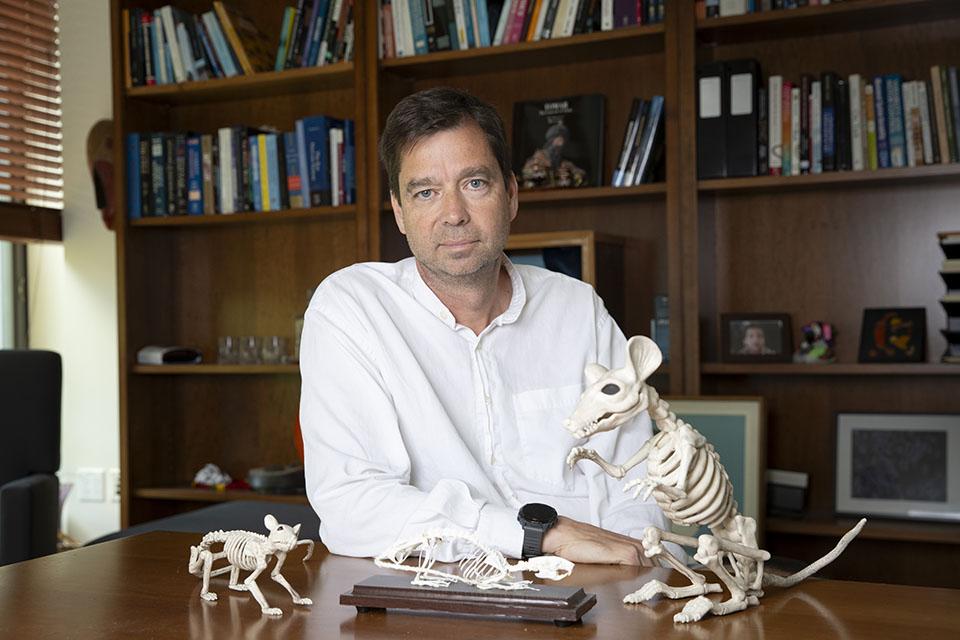
Bence Ölveczky is a professor in the Department of Organismic and Evolutionary Biology at Harvard University. A mechanical engineer by training, Ölveczky earned his Ph.D. in neuroscience from Harvard University, working with Markus Meister on motion processing in the retina. As a junior fellow in the Harvard Society of Fellows, Ölveczky worked with Michale Fee at the Massachusetts Institute of Technology on the neural mechanisms of vocal learning in songbirds.
The Ölveczky lab is interested in how motor skills are learned and generated by the brain. They study this in rodents, generalist motor learners with the capacity to master a variety of different tasks. The lab has developed a unique experimental infrastructure to address these questions, including a fully automated high-throughput training system for rodents that can be combined with continuous long-term neural and behavioural recordings. They use this together with sophisticated circuit dissection tools to arrive at mechanistic descriptions of how the mammalian brain learns and executes motor skills.