Where the mind points before the body follows
22 September 2026
Twelve years ago, Professors John O’Keefe, Edvard Moser and May-Britt Moser were awarded the Nobel Prize for Physiology or Medicine for their discovery of the brain’s ‘inner GPS’ - place and grid cells. These cells allow us to build a map of, and navigate through, the world around us.
Now, new research from Neil Burgess, Professor of Cognitive and Computational Neuroscience at UCL and O’Keefe, Group Leader at the Sainsbury Wellcome Centre at UCL, has shown how these cells not only represent the animal’s current location, but also locations it is interested in.
Their work, published in Nature Neuroscience, focuses on the role of ‘theta sweeps’ – the rapid, rhythmical firing patterns of neurons in the brain. Ten times a second, place and grid cells fire in a specific sequence. They first pinpoint the animal’s current location and then the way ahead. Until now, the function of these sweeps has been debated.
Do they represent an animal's movement trajectory, the available paths, or a target they can see or hear? Or do they represent a plan of where an animal wants to go?
The work, led by Dr Changmin Yu at the Gatsby Computational Neuroscience Unit, includes an analysis of neural activity data from animals traversing through a maze, trying to reach a rewarded location – with a total of 137,651 theta sweeps.
The team found that theta sweeps form a key part of the ‘cognitive map’, encoding the direction of the animal’s goal, independent of what it senses or where it is moving.
Separation
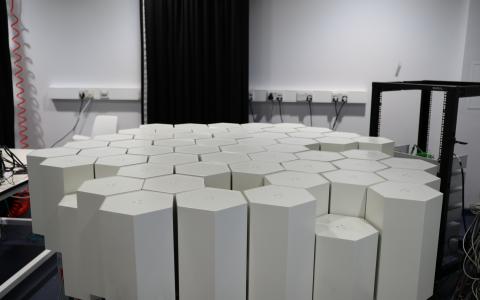
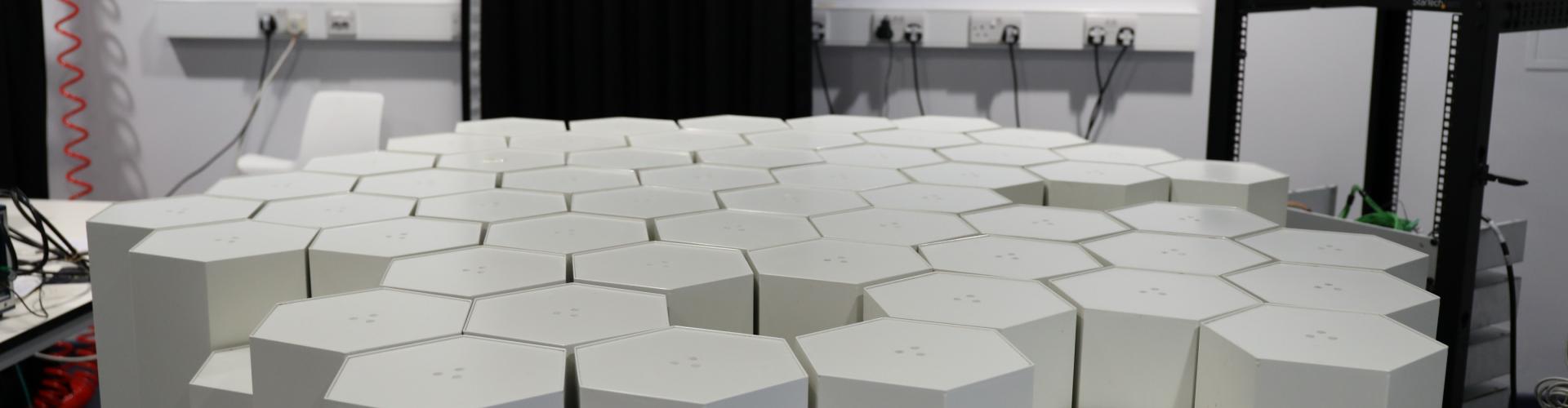
The key to the discovery was the honeycomb maze, says Dr Yu. The maze, developed by O’Keefe’s lab, allows investigators to separate an animal's movement-, head- and goal-direction.
It achieves this with 61 moving hexagonal platforms which an animal navigates across towards a reward. At each location on the maze, an animal waits before more sections of the path appear. It then has a binary choice for its next move and the most efficient path towards the goal¹.
Recording neural activity while the animal makes each choice, then moves, allowed the team to uncover the underlying brain mechanisms at each stage.
“We found that an animal is constantly thinking about where the goal is in relation to its own position, even if it can’t go that way”, says Dr Yu. “Then, path integration is used to update this goal-directional estimate.”
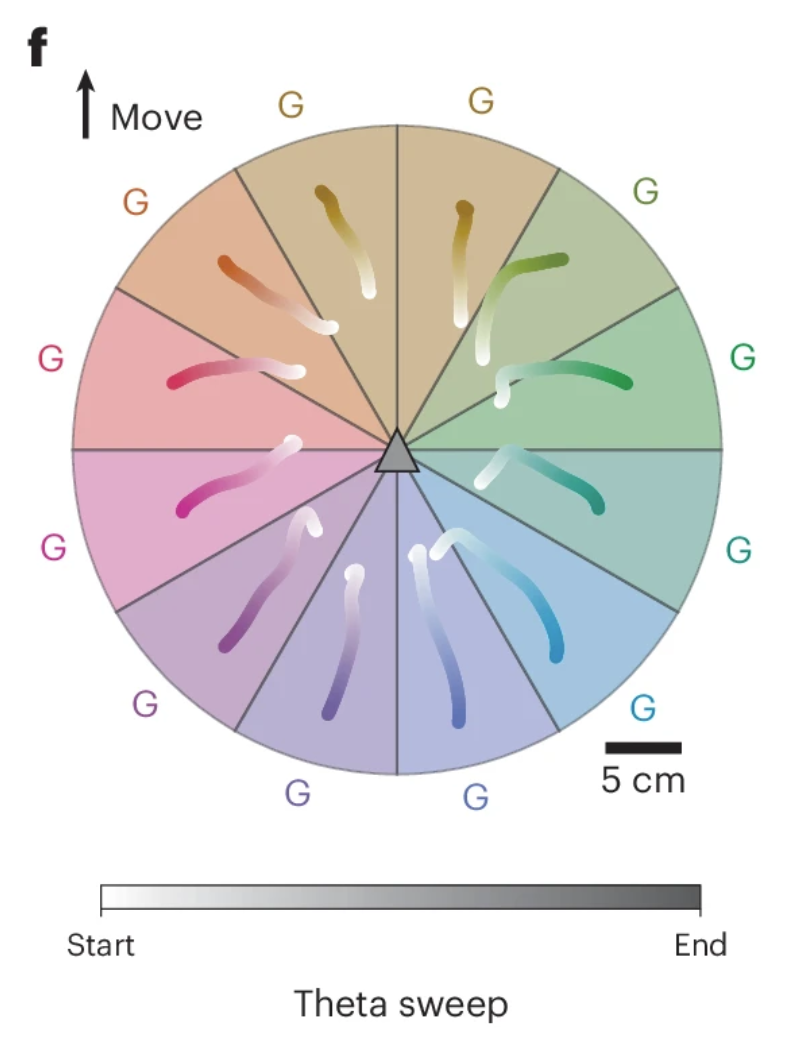
Figure showing median decoded theta sweep locations relative to the animal (grey triangle at centre) as a function of goal direction (colored ‘G’s) relative to the movement direction (upwards). Adapted from Yu et al. 2026, under a Creative Commons Attribution 4.0 International License.
The team found that theta sweeps consistently point toward the remembered goal location, regardless of which way the animal is facing or moving. The goal-direction signal grew stronger in the moments before a correct choice and sharpened with experience, tying the effect directly to task performance. They found the same pattern in a second maze task, too.
“It’s taken almost 50 years to verify the prediction of the cognitive map theory that the hippocampus pointed the way to the goal as well as the identifying [the] animal’s current location. We needed to develop population recording techniques and special testing apparatus like the honeycomb maze before we could see it,” says Professor O’Keefe.
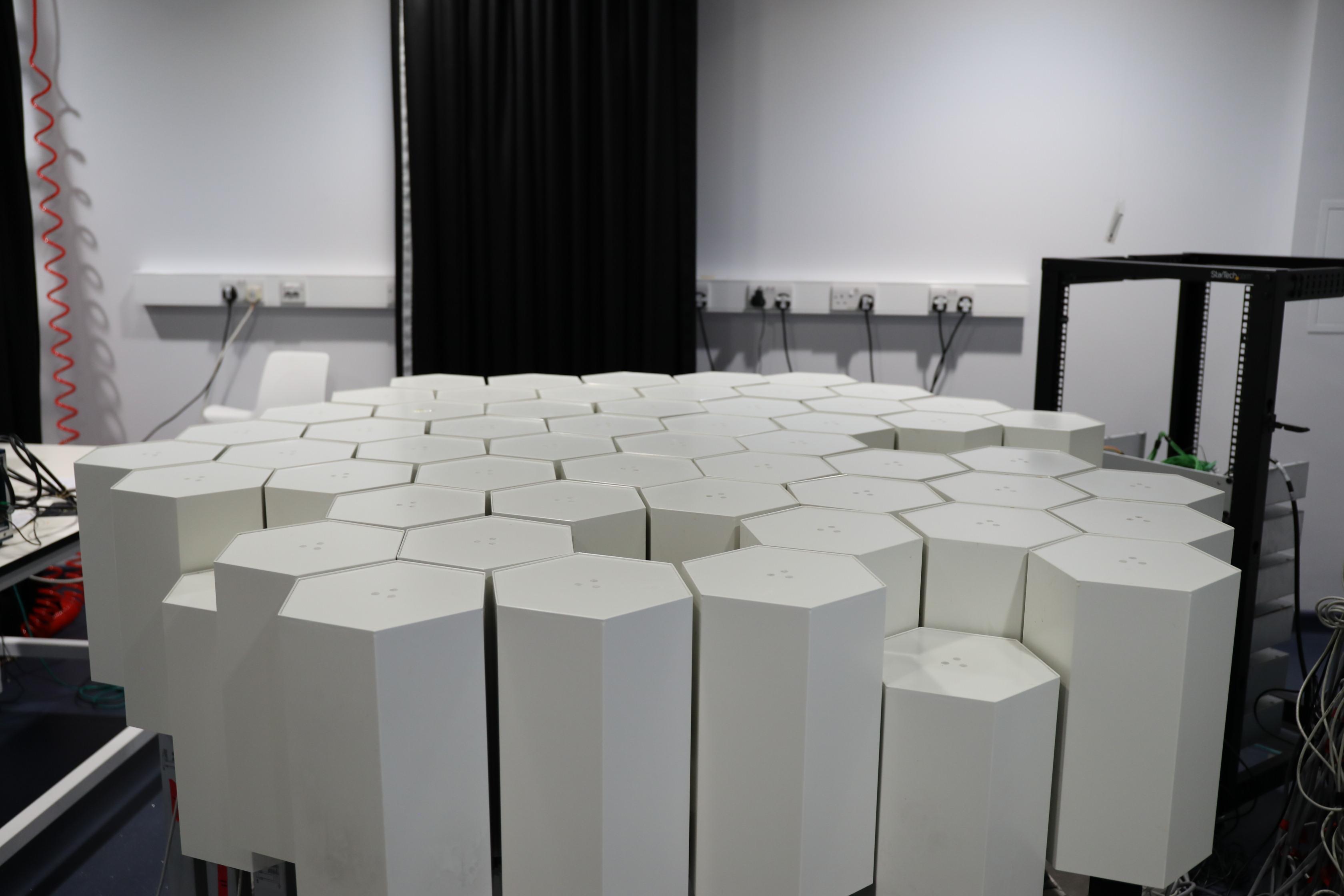
Honeycomb maze at the Sainsbury Wellcome Centre.
Collaboration
“The flexible arrangements for cross-disciplinary collaboration are one of UCL’s greatest strengths”, said Professor Neil Burgess, whose primary affiliation is at the UCL Queen Square Institute of Neurology. “This work was only possible due to close affiliations with the Sainsbury Wellcome Centre, the Institute of Cognitive Neuroscience, the Gatsby Computational Neuroscience Unit and the Department of Cell and Developmental Biology.”
The team also created mathematical models of the underlying neural circuitry - these reproduced the result, as well as several further predictions the team then confirmed experimentally.
The end of a debate?
Two other research papers were published around the same time as the Nature Neuroscience study, one from the Mosers at the Kavli Institute for Systems Neuroscience in Norway², and the other from Professor Fernandez-Ruiz at Cornell University in the US³. These investigations used different experiments but came to similar conclusions; theta sweeps indicate where the animal is thinking about going.
“These findings answer a question that has been haunting me for my whole career: if place cells represent your own location, how we represent the locations of other places that you need to visit or avoid? A map of just your own location would be useless. Now we have an answer, I think it will catalyse further breakthroughs in understanding the neural mechanisms supporting flexible planning, in conceptual as well as physical spaces,” says Professor Neil Burgess.
References:
- Honeycomb maze reveals role of hippocampus in navigation decisions
- Adaptive modulation of theta sweeps in the brain’s navigation circuit
- Goal-directed hippocampal theta sweeps during memory-guided navigation
Media contact:
For more information or to speak to the researchers involved, please contact:
Alison Cranage
Research Communications and Engagement Manager, Sainsbury Wellcome Centre
E: a.cranage@ucl.ac.uk T: +44 (0)7917 922 068