
Allen Institute brain atlases released in a standardised format through BrainGlobe
16 November 2026
Allen Institute reference atlases are now available in a standardised format through the BrainGlobe Atlas API, following a collaboration between the Allen Institute and the BrainGlobe team at the Sainsbury Wellcome Centre (SWC), UCL. Built on an open atlas schema, the update makes it easier to map and compare diverse datasets in a shared 3D coordinate space, and to build new tools and workflows on top of them.
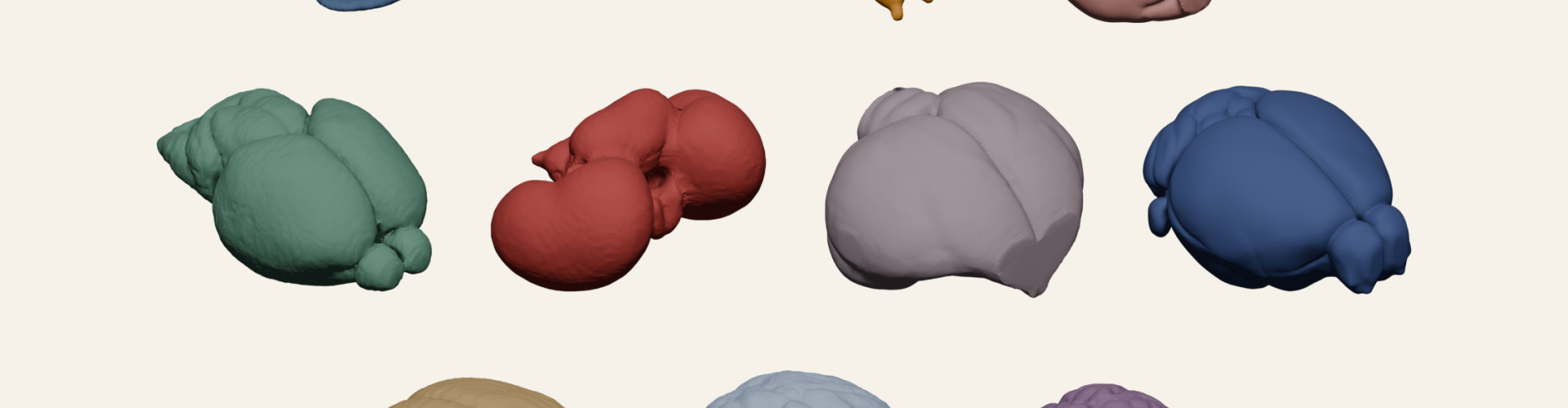
Atlases form foundations for many neuroscience studies, providing scientists with a shared map and a coordinate system for locating and naming brain regions. Essential for experiments seeking to understand how the brain drives behaviour, they enable images and experiments to be aligned to the same reference and results to be compared between studies. 3D atlases have been produced by research groups around the globe, with over 15 species now available. The BrainGlobe Atlas API allows researchers to easily access a wide range of atlases across species, developmental stages and imaging modalities.
In the new update, an atlas is no longer a single file. It is a set of independently versioned components, stored in open formats that are downloaded only when needed. The layout follows the Atlas Asset Organization from the Allen Institute. Separate components mean that download times are reduced, and scale with analysis needs rather than the size of the atlas. Researchers can also pin the exact version of an atlas they used, so that analyses can be reproduced at a later date.
“Working with the Allen Institute has helped make BrainGlobe ready for the atlases of the future, and a foundation others can build their own tools upon. We hope it encourages more people to get involved.” – Dr Adam Tyson, Head Research Engineer at the Sainsbury Wellcome Centre, and co-founder of BrainGlobe.
Atlas API
The BrainGlobe Atlas API was originally built to address the issue that many brain atlases do not come with their own API. And, for those that do, they often require substantial coding skills to use. Built in Python, the BrainGlobe API is concise, users don’t need to have extensive coding experience, and comes with full documentation.
“Modernising and standardising the way atlases are stored and distributed not only improves the analysis experience but also streamlines the process of adding new atlases to the BrainGlobe ecosystem. New atlases that adhere to the open standard can be made immediately available within the BrainGlobe Atlas API.” – Igor Tatarnikov, Senior Research Software Engineer at SWC, who co-leads the development of the BrainGlobe Atlas API.
“Anatomical atlases are easy to look at but hard to use, especially between research groups. Working with the SWC, we created the Atlas Assets framework, an open schema that standardises atlases and empowers users to build, share, and use atlases together. We’re excited to partner with the BrainGlobe team because of their expertise in building computational neuroanatomy tools with a dedicated user base. This data standard gives the neuroscience community the tools they need to integrate their data together with a shared language in a common space,” said Dr Ashwin Bhandiwad at the Allen Institute.
The teams hope the updated API will enable more researchers to access and use brain atlases. They invite the community to build on this shared foundation for neuroscience.
Find out more
- BrainGlobe Atlas API (brainglobe-atlasapi): documentation
- BrainGlobe blog: brainglobe-atlasapi V3 is here
- Paper in the Journal of Open Source Software: BrainGlobe Atlas API: a common interface for neuroanatomical atlases
- Allen Assets Organisation on GitHub: https://atlas-assets.readthedocs.io/en/latest/index.html


