It's not the wiring that matters. It's the rhythm.
20 May 2026
If you smell smoke, what do you do? If you can see your toast burning, then it is unlikely to be anything to worry about. Perhaps you open a window. But if you wake up and smell smoke in the middle of the night, with the alarm blaring and you can see light under the door, it could be life-threatening. The same sensory signal – smoke – becomes much more urgent. You might run.
Knowing when to escape is an essential skill for survival. Any animal must be able to decide, very quickly, if it needs to flee.
A small cluster of neurons deep in the midbrain, called the periaqueductal grey (dPAG), is known to be the brain’s escape command centre. It receives signals from dozens of different brain areas simultaneously.
This includes sensory signals from the mid-brain – the sound of an alarm - contextual information from the cortex – what am I doing – as well as motivational state from the hypothalamus, amongst others. But how are these inputs balanced to arrive at a decision, and at a speed that is fast enough to matter?
New research from Yu Lin Tan and colleagues at the Sainsbury Wellcome Centre shows that in mice, the timing of inputs to the dPAG determines their influence. This defies the conventional expectation: that, like in other areas of the brain, it's variations in the physical connections between neurons that regulate the strength of an input.
The work, now published as a pre-print, shows how the dPAG ‘listens’ to multiple inputs, which can rapidly be dialled up or down, providing a way for different factors to quickly affect a decision.
Wiring vs timing
Studying mice in naturalistic settings, the team led by Group Leader Professor Tiago Branco and Senior Research Fellow Dr Dario Campagner, looked at the brain’s escape circuits at multiple levels. This included collecting neural recordings from multiple brain areas during different escape behaviours, all the way down to stimulating individual synapses. They also employed a generalised linear model (GLM) to predict the effects of one neuron on another. This comprehensive approach revealed that if upstream neurons are firing in tight, rapid bursts, or large numbers of them are firing in synchrony, they carry more influence. This was regardless of how they are physically connected.
“At first, we looked specifically for a dendritic mechanism, or differences in the synapses. We didn't find either, and that was unexpected,” says Professor Branco. "You could describe the system as a tabula rasa [a blank slate], with the only thing that matters being the timing. I think that is quite surprising and a unique finding."
They found that this is enabled by a property of the dPAG neurons themselves: their branching structure is electrically compact, meaning every input arrives at full strength. Normally, signals from synapses far from the cell body fade as they travel, but the compact geometry of dPAG neurons means this fading is negligible, so distant inputs carry as much weight as nearby ones.
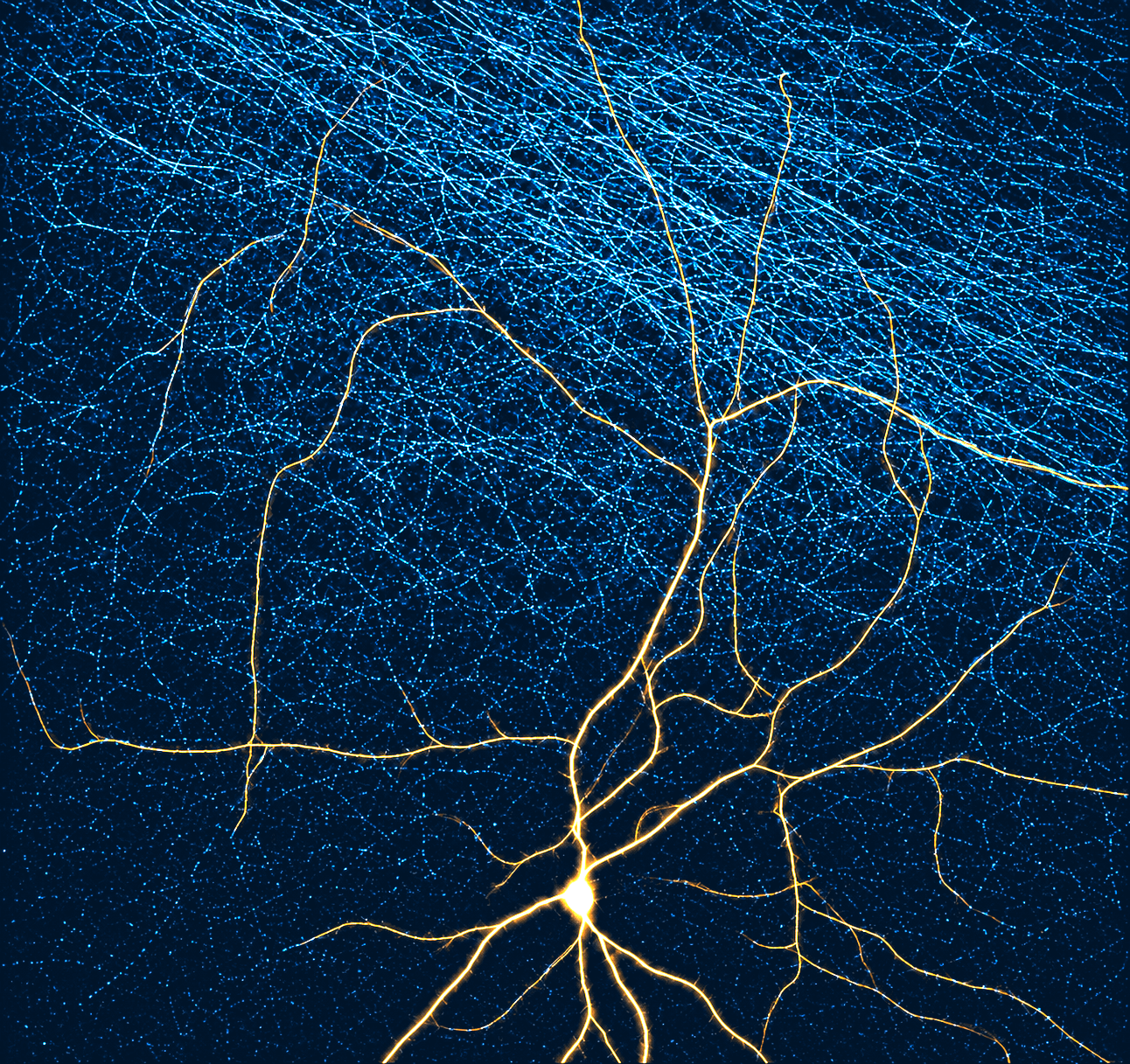
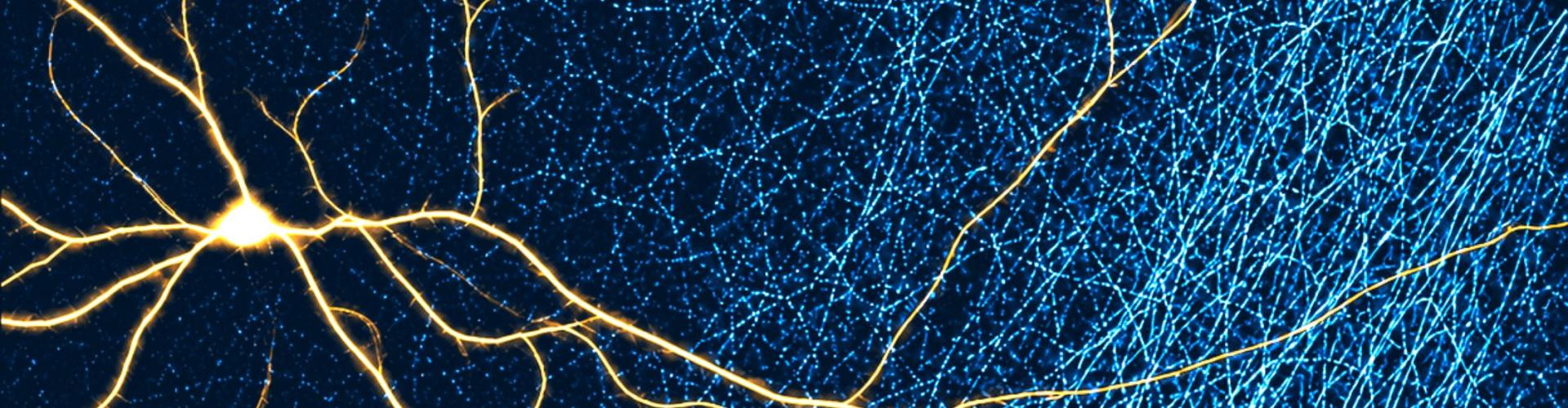
Image showing a dPAG neuron (gold) and surrounding input axonal fibres (cyan), reconstructed from original microscopy data. Credit: Yu Lin Tan and Dario Campagner.
A rich dataset
Beyond escape decisions, the team also recorded neural activity from mice during a wide range of learned and innate behaviours. This included cricket hunting, navigating to find food, male interaction with females, as well as responses to predator odours and naturalistic sounds. Each of these conditions activates the dPAG and its input regions differently.
This breadth not only improved the GLM, but it also makes the dataset one of the richest recordings of neural activity during natural behaviour currently available.
The dataset holds further advantages over methods previously used to study the dPAG. “Simultaneously recording single units across the PAG and its input regions in freely behaving mice gave us something unique: the temporal precision needed to infer how these regions communicate, in a way that recordings from separate experiments or techniques such as calcium imaging cannot provide,” explains Dr Campagner.
Beyond escape
The mechanism the team has uncovered shows how the brain can rapidly shift which signals it ‘listens to’ without rewiring anything - simply by changing the rhythm of upstream activity. They confirmed this directly, showing that the influence of cortical input could be turned up or down within behavioural timescales during moments of motivational conflict.
“Evolution has wired the escape circuit to everything that should affect an escape decision. The elegant thing is that each input is treated the same – whether it is visual or auditory, or something internal like hunger. This allows the escape centre to respond quickly and flexibly, only dependent on the timing of inputs,” said Dr Campagner.
They expect that other circuits in the brain – specifically behaviours that might affect survival, like whether to fight an opponent, collect food or approach a potential mate - could work in the same way. The team now plan to investigate how an individual dPAG neuron integrates different inputs in real time to generate the final escape decision.
If the principle holds beyond the escape circuit, it may represent a fundamental solution to one of the brain's hardest problems: how to make the right decision, from competing signals, in the time it takes to run. The next time you smell smoke and feel your heart race, your dPAG is doing exactly that.
Find out more
Presynaptic temporal dynamics flexibly set input weights in the mouse escape circuit