The language of geometry
23 February 2026
Bees build hexagonal hives, spiders spin webs with multiple sides and spokes, and some fish draw spirals in the sand. But only humans produce and recognise a wide range of geometric patterns.
This ability is seemingly as old as humanity itself, with geometric engravings found in Blombos Cave, South Africa, dating from 70,000 years ago, and zigzags on a seashell in Java, dating back 500,000 years.
It was research published in 2021 by Dr Mathias Sablé-Meyer and Professor Stanislas Dehaene, based at the Collège de France, that first showed how we differ from other primates in our capacity to perceive geometric shapes.
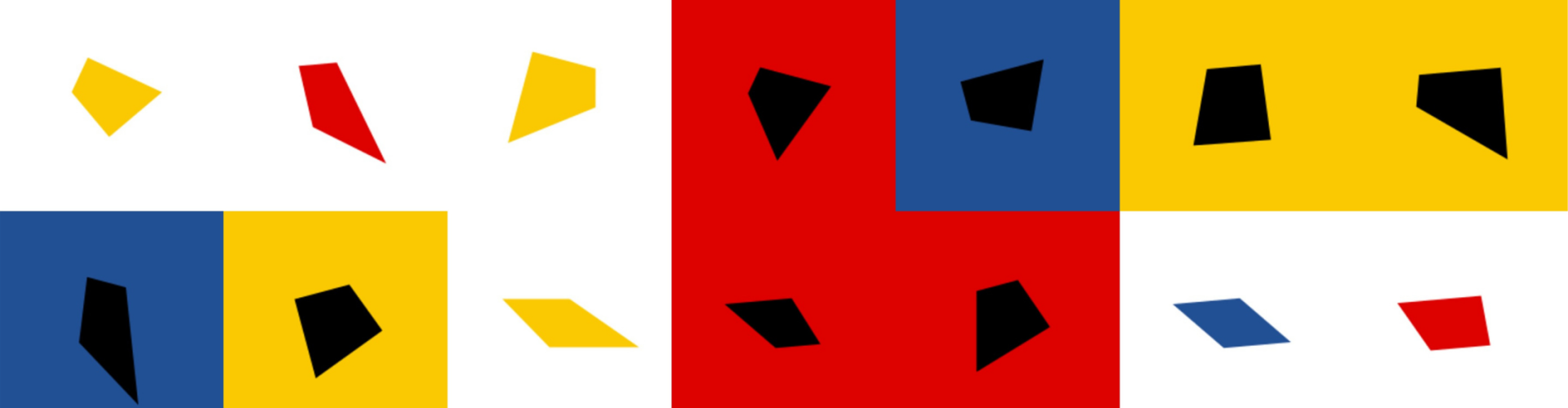
They found that humans, including both young children and adults without formal western education or a language that describes geometric shapes, care about regularities such as symmetries, parallel lines and right angles. We perceive squares, rectangles and parallelograms as simple, and easier to recognise than other irregular-looking quadrilaterals. No matter how much training baboons were given, they could not make such distinctions.
Now based at the Sainsbury Wellcome Centre at UCL, Dr Sablé-Meyer has published follow-up work in eLife. The research, undertaken during his PhD at the Collège de France and NeuroSpin (CEA) where the data was collected, uses fMRI and MEG brain imaging to better understand the mechanisms that underlie our ability to recognise and encode geometric regularities.
The results provide direct evidence for the existence of two separate brain networks with different ways to represent shapes. The team proposes that humans have an internal, innate ‘language of geometry’ and that we represent shape in this internal language and not as visual objects.
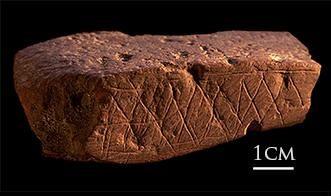
Ochre stone found at the Blombos Cave site. The pattern dates from approximately 70,000 years ago. Image Credit: Chris S. Henshilwood via Wikimedia, under Creative Commons Attribution-Share Alike 4.0 International license.
Geometry in the brain
Humans differ from other animals in many ways. Language is an obvious visible difference, but Dr. Sablé-Meyer studies another domain: geometry. Geometry is simpler to study than language, free from the confusions of linguistics and communication, but it still may reveal ways in which our brain works.
“Humans are really good at representing all sorts of abstract things, abstract concepts, and making concepts out of other concepts and so on. In our mental representation of geometric shapes, there is some level of abstraction and compositionality. It is a route into questions of how we represent the intangible,” he explains.
While researchers have a deep understanding of how primates see the world, how we recognise and encode geometric patterns has been unclear. Is it related to how we read? Or perhaps to the way we grasp mathematics?
Watch Professor Stanislas Dehane's lecture, 'The science of reading: From neuroscience to the classroom.'
To identify the regions involved, the researchers used brain imaging techniques, fMRI and magnetoencephalography (MEG). They found that simply looking at shapes first involves ventral visual areas, though the activity here was less than when viewing pictures of objects or faces. Then, the intraparietal and inferior temporal regions of the brain are activated. These areas are linked to areas identified in mathematical processing, though it remains to be seen if the two domains are supported by exactly the same circuits.
The team also undertook an online experiment, where 330 participants were tested on their ability perceive and compare shapes.
Computer models support the idea that, rather than relying purely on visual impressions, people seem to recognise similarities between shapes by using abstract rules. Simple AI systems, designed to mimic visual processing in primates and process images in a pixel-by-pixel way, could replicate the brain’s earliest responses to shapes. These algorithms can also explain the baboon’s responses in the previous study. But they failed to explain what happens next in humans. Activity in the higher temporal and frontal brain regions only made sense when researchers used models that represent shapes as collections of discrete geometric features.
“We propose that in humans, mental representation of shapes rests on a symbolic internal 'language of geometry',” says Sablé-Meyer. This goes beyond object recognition, which is similar in human and non-human primates, and beyond simple visual processing. In this format, shapes could be represented by symbolic expressions, for example, 'a square is a four-sided figure with four equal sides and four right angles'.
“The results show us that whenever we process information, even if there's nothing specific to be done with it, we really try to find the highest-level abstract representation that is useful to represent the world,” he adds.
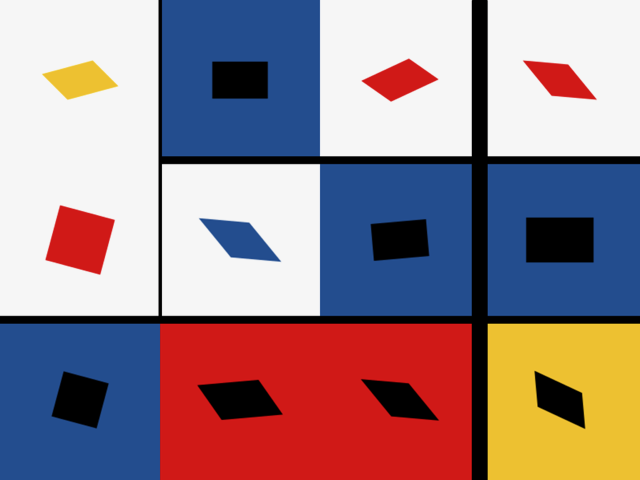
Stylistic representation of some of the geometric shapes used in the studies. Credit: Mathias Sablé-Meyer.
Mysteries of the mind
Dr Sablé-Meyer moved to SWC in 2023, with the goal of understanding in more detail how the brain represents abstract or symbolic information. Using studies in both rats and humans, he is investigating which neurons and circuits bring complex thoughts to life.
Reflecting on his motivations, he is philosophical. “The high-level, big research question I care about is the mystery of the human mind. It does all sorts of magic tricks, like language and reasoning. We all have a mind, but none of us understands how it works or what it means to have one.”