
Mice wiggle the wheel
18 May 2026
If you can't find the cursor on your computer screen, you may find yourself shaking the mouse to make it visible. Bingo, you can see it. New research from Dr Naureen Ghani at the Sainsbury Wellcome Centre (SWC) shows that some mice discovered a similar trick in a visual perception task.
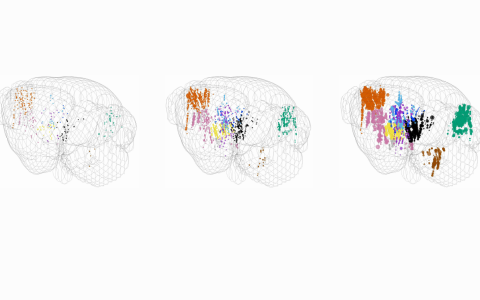
The research draws on data from the International Brain Laboratory (IBL), a collaboration in which mice from 12 laboratories across three countries were studied. The IBL recently unveiled the first brain-wide map of decision-making at cellular resolution. During the IBL research, mice were trained to use a miniature steering wheel to centre a visual stimulus on a screen, earning a reward for correct responses.
During her PhD at SWC, Naureen was watching video recordings of these mice when she noticed something unexpected: some animals made small, rapid twists of the wheel before committing to a direction. They did this most often when the visual contrast was low and the task was hardest. When they made these movements, their accuracy went up. The research is published in iScience.
Why did these mice wiggle the wheel? Because it is easier to see something moving than something stationary. When a mouse shakes the wheel, the visual stimulus moves back and forth across the retina. The visual system is wired to detect movement, so this means mice can perceive the image better. Naureen's analysis confirmed that the speed of the wheel movements fell precisely within the range that maximises visual contrast sensitivity in mice.
“Wiggling is a lovely discovery, showing that some of the mice enjoy a surprising degree of behavioural flexibility. That wiggling is determined by contrast suggests that they even exhibit a form of control over control or meta-control -- no wonder Jerry regularly bested Tom,” said Peter Dayan, the Director of the Max Planck Institute for Biological Cybernetics in Tübingen, Germany.
This behaviour is an example of active sensing – the use of self-generated movement to gain sensory information. Rodents in the wild will use head-bobbing, whisking, and sniffing to gain information from their environment – this might be temperature or odour, for example. This new study reports the first time that active sensing has been observed in a visual laboratory task, where mice interact with their environment through a wheel.
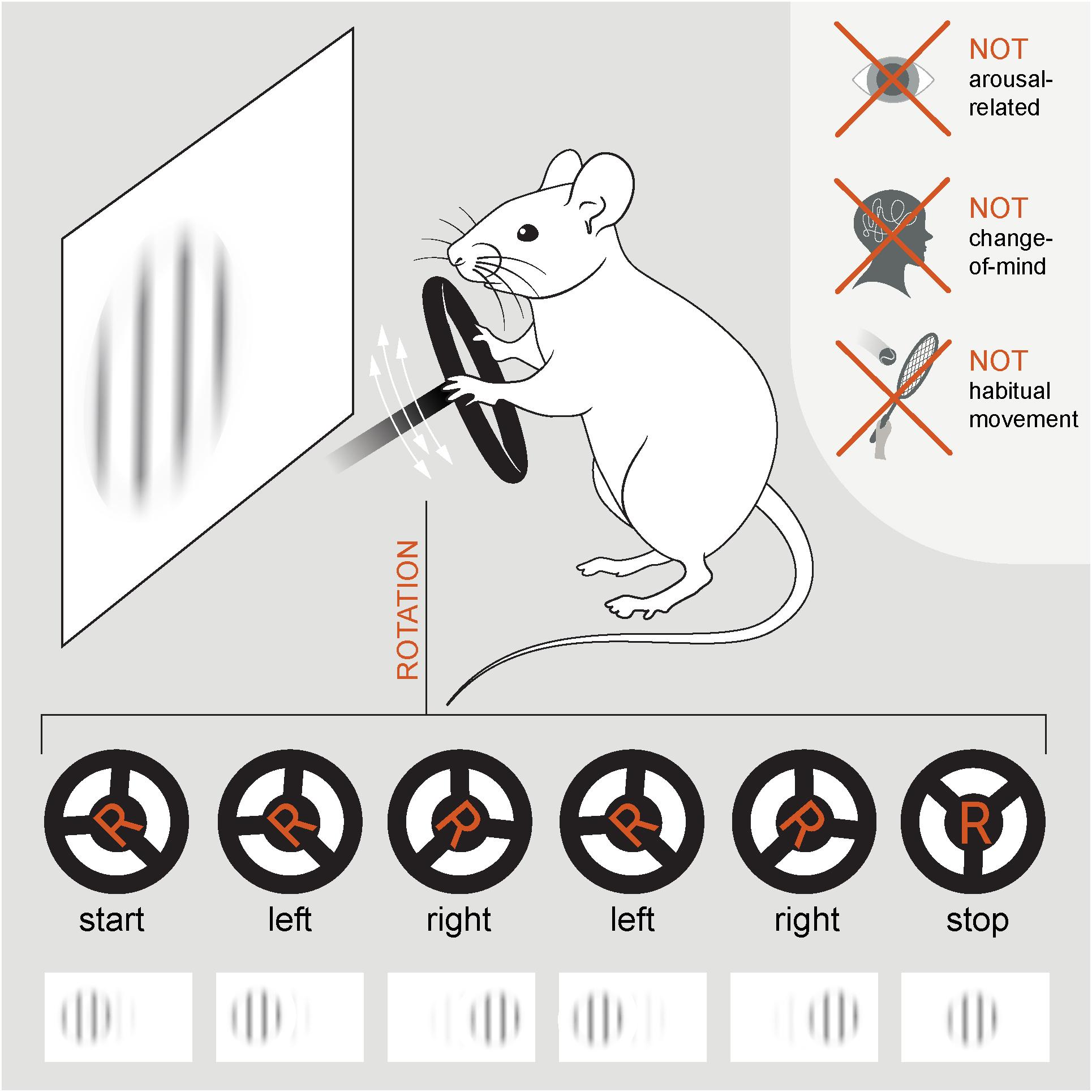
Illustration showing the task where a mouse has to move a wheel to centre a visual stimulus on a screen. Credit: Julia Kuhl.
This means that researchers can now record exactly what neurons are doing as a mouse actively samples visual information using a wheel. “The combination of clever mice and a clever researcher has given us a better understanding of what subjects are actually doing when they perform the tasks that we assign to them,” said Larry Abbott, the William Bloor Professor of Theoretical Neuroscience at Columbia University.
Wheel wiggling can also serve as a marker of learning. Even when the strategy was not needed to solve the visual perception task, as with low resolution stimuli, the mice that discovered it continued to exploit it.
“Looking at overall performance, all the mice reach about 90% accuracy in the task, but that final result doesn’t show us how the mice learned what to do. How they get there varies between individuals, just as it does in humans,” said Naureen.
Of the animals studied, about half of the mice used wheel wiggling to better perceive low-contrast visual stimuli. A further 30% mice showed no clear relationship between wiggling and accuracy. The remaining mice wiggled the wheel when they were disengaged - statistical modelling revealed that these mice were more impulsive and eager for a reward. Variation between mice was greater than the variation within any single mouse.
“Naureen’s analysis highlights the intrinsically active nature of sensation,” said David Kleinfeld, the George Feher Professor of Experimental Biophysics at the University of California, San Diego. “The animals had not received any instruction to wiggle the wheel. Yet a large cohort of the IBL mice from laboratories spread across Europe and the United States intuitively adopted a strategy that exploited the improved visual perception of moving rather than static objects. Perhaps future work by Naureen and others will discover new modes of object manipulation that are used for improved sensation.”
Find out more
iScience: Active sensing during a visual perceptual decision-making task