The grammar of movement
27 October 2026
Language has grammar – rules that allow words to be combined into sentences and meaning, with endless possibilities. Many neuroscientists argue that our movements do, too. For example, a gymnast may know a variety of moves to tumble across the mat, from cartwheels and backflips to somersaults, as well as how it is possible to link them together.
This system, of component parts and rules for recombination, allows us to generalise. Just like you can read a new sentence and understand it, ask a gymnast to perform a new routine – say, nine cartwheels then a backflip – they will be able to, first try. Taking what we know and applying it to new situations is a hallmark of intelligence.
Grammar is thought to underlie everything from musicianship to structured reasoning in maths, to social reasoning. But where and how it is implemented in the brain remains unclear.
Dr Lucas Tian, Assistant Professor at NYU, studies the neural representations of action grammar. As a winner of the Emerging Neuroscientist Seminar Series, Dr Tian recently spoke at SWC about his work, and in this Q&A he shares his latest findings.
Could you tell us about your work – what are the key questions you are studying?
One of the fundamental things the brain does is allow us to do new things.
The brain learns things, but it's also able to somehow very rapidly go beyond what it's learned to either create new thoughts, create new behaviours, or new understanding. You do it every time you talk to someone; you've never heard that specific stream of words before, but it makes sense to you.
What I'm trying to understand is the computational principles in the brain that allow us to do that.
Obviously, speech is one example where we have a grammar for creating new things – in this case, sentences. But the idea is that this is a very general property of the brain beyond language.
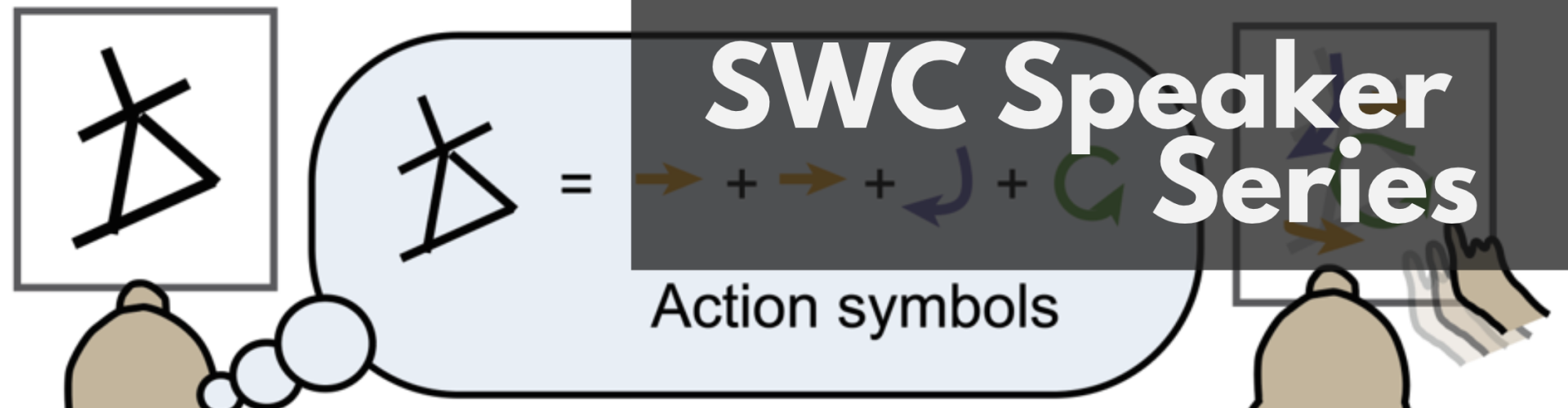
The particular domain I study is having monkeys generate new drawings. I prompt the monkey on a touchscreen with images that they have to reproduce by performing strokes on a touchscreen. They are not told what stroke shapes to use, nor what specific order to sequence those strokes. They have been taught concepts like how to draw basic shapes, like a line or circle, which you can think of as discrete symbols, and grammatical rules, such as how to repeat or connect shapes. These are abstract concepts that form the ‘language’ that these monkeys have learned for drawing. But the specific images in the task, they have never seen before, and so they have to come up with an overall action sequence. Monkeys successfully drew new images in a manner consistent with the underlying grammar.
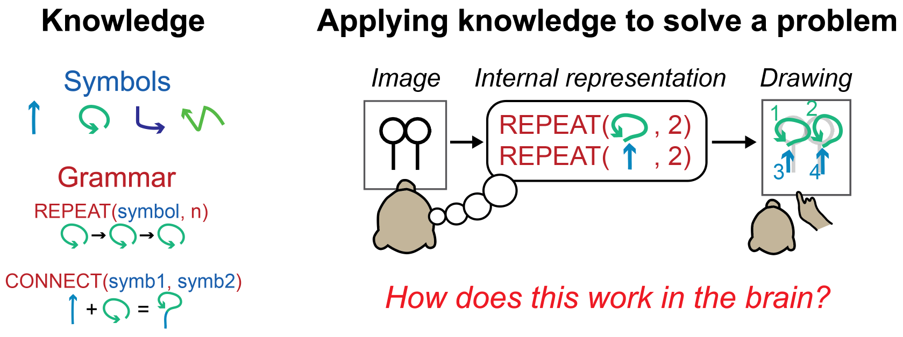
From recording neural activity in the brain, we have found specific activity representing this grammar in the pre-supplementary motor area (preSMA).
Could you tell us more about what that part of the brain does?
If you just look at the firing properties of neurons in the preSMA, as the monkey is drawing, it is like an internal representation of the entire structure of what the animal is planning to do.
It's not just representing ‘now I'm doing a circle’, or ‘now I'm doing a line’, but it's representing the circle as a specific object in a sequence of shapes, where the sequence is represented in preSMA activity as an abstract program, like “Repeat circle twice, then repeat line three times”. So the activity represents a monkey's abstract understanding of the overall action plan.
Out of all the areas we recorded from, across many areas in the frontal cortex, this representation was substantially stronger in the preSMA.
This area of the brain is, I think, understudied, but it's very interesting. It has been implicated in the ability to organise your own behaviour.
There is evidence that people who have damage to the preSMA exhibit difficulty coming up with a new sentence to answer a question. These same people can be fine if you say a sentence and you ask them to repeat it back to you. The difficulty is in self-generating actions.
The connection that I hope to make in the future is that the general principle in this area is representing grammatical structure for creating behaviours.
In your earlier work you found that the action symbols themselves are represented in a different area, ventral premotor cortex. So is this a two-part system with building blocks in one place and then recombination rules, or grammar, in another?
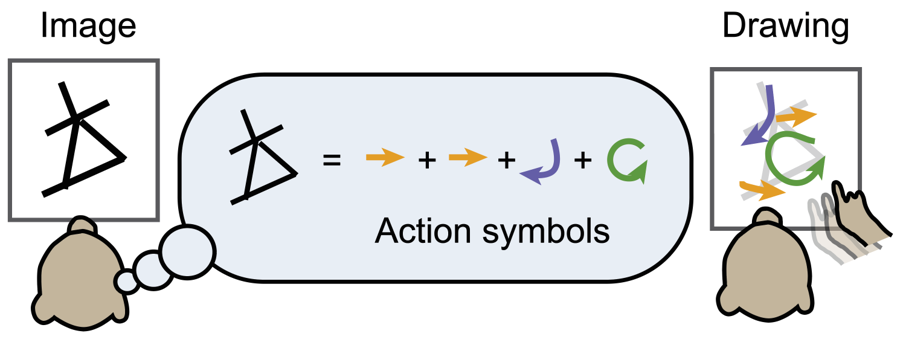
That's one of the key take-homes. If you have a recombination system, you need something to recombine. And ventral premotor cortex, or PMv, is the area where we see these - essentially a ‘vocabulary’ or ‘library’ of action types. In humans, this might correspond to different kinds of grasps, like grasping a mug or grasping a cup.
What might your findings mean for understanding how humans think?
One thing that is already clear from this is that motor behaviour actually involves highly abstract, symbolic internal representations. This is not very obvious if you think of motor behaviour, as it seems to be all about physical movements. But what these studies show is that even in that context, there are abstract underpinnings that resemble language.
It’s hard to see in humans, because it’s hard to study activity of neurons in this systematic way. But it has implications, including for thinking about brain-machine interfaces. If we want to think about how to help people recover from stroke or other kinds of disorders that impair movement, one possibility is to try to decode high-level intentions in the abstract representational space. This is different to the current dominant paradigm, in which brain-machine interfaces decode from lower level motor areas.
It's not just about how humans control their body. Longer-term, I want to build on these insights into the cognitive aspects of motor behaviour to understand the most abstract forms of human thought.
Is there evidence that this circuitry might support abstract non-motor reasoning?
There's some cool evidence in humans. If you ask humans to imagine actions, like I show you a picture of a tool and say, how would you use this, you can see in functional imaging studies that these same regions often light up. The ventral premotor cortex and the pre-supplementary motor area. That gives me some indication that it's involved in thinking about action and mentally simulating what would happen if you acted one way or another. There is also evidence in human functional imaging that these areas are involved in abstract problem solving as components of the so-called multiple demand network.
In my lab, what I want to do is on one hand, study monkeys to understand mechanistically how things work. We can record and manipulate neurons. And at the same time, study humans intracranially. We can do this as they're doing really human things, like imagining or drawing. We can record from a range of areas. The aim is to bridge this gap between biological mechanisms and the high-level abstract creative capacities in humans.
Why did you become a neuroscientist?
I’ve wanted to do neuroscience for a long time, since I was in my early teens. It's fundamentally just the mystery of who we are. It's all the amazing things we experience as humans, like our memories, our imagination, our ability to learn skills and solve problems and talk to each other. This all comes from a lump of tissue in your head. It’s just an organ, just like your lungs. And we know how our lungs work more or less. But we have no idea really how the biology of the brain generates us. That's really amazing.
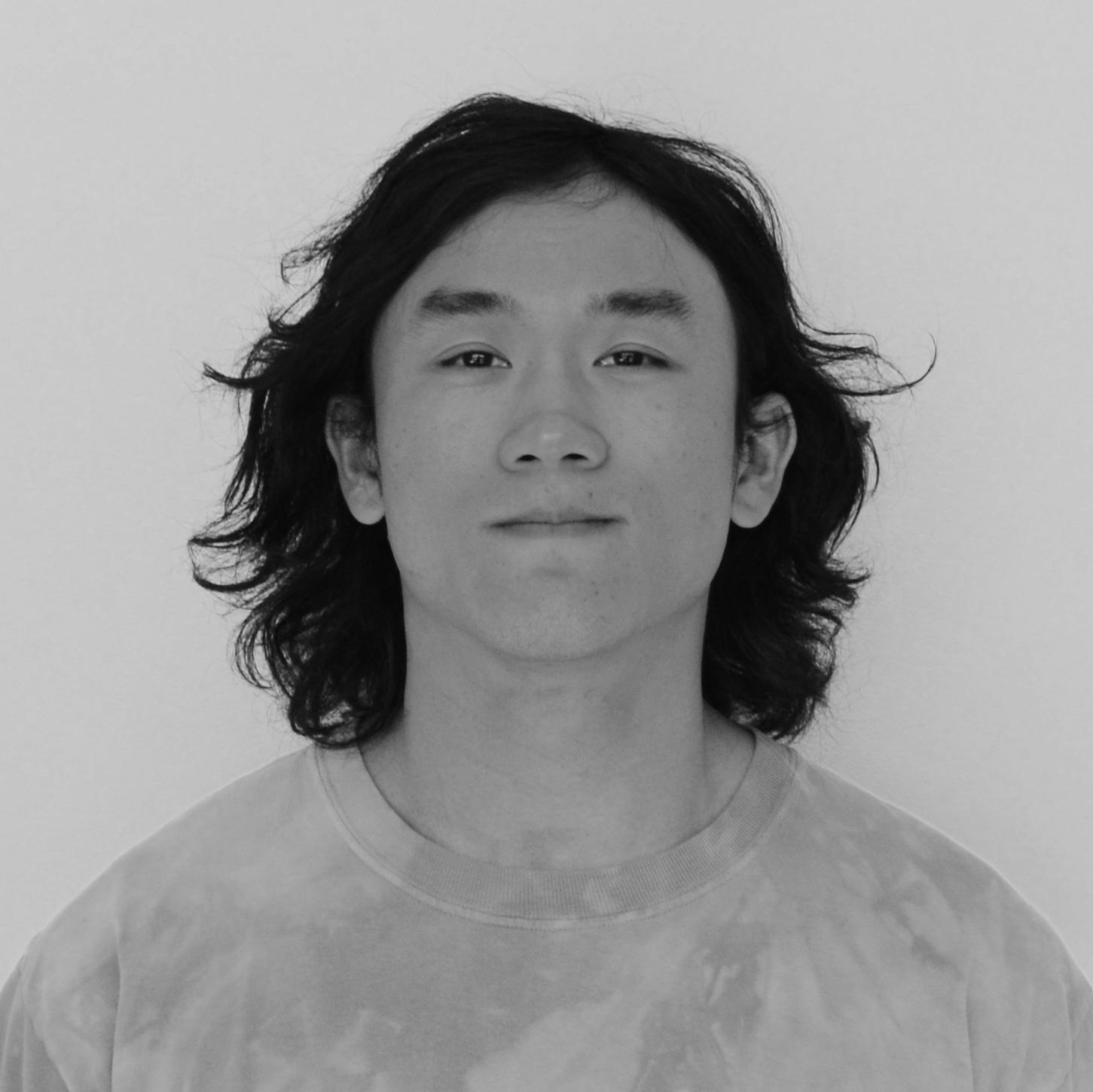
Biography
Lucas is a systems and computational neuroscientist fascinated by the brain’s remarkable ability to generate new representations that instantiate novel ideas and behaviours, an ability critical for general-purpose intelligence. Towards this, he specifically studies how primates solve physical problems by constructing grammatically structured action sequences, and does so by combining behavioural, cognitive, neural, and modeling studies in macaques and humans. He is a postdoc with Winrich Freiwald (Rockefeller) and works closely with Josh Tenenbaum (MIT) and Xiao-Jing Wang (NYU). His Ph.D. was on circuit mechanisms of motor skill learning in songbirds, with Michael Brainard (UCSF). In his free time he rides his motorcycle through the winding roads of upstate New York.