Asking hard questions: The SWC/Gatsby Unit annual symposium
26 June 2026
A decade ago, the Sainsbury Wellcome Centre (SWC) opened its doors with a bold ambition: to understand how the brain generates behaviour. In partnership with the Gatsby Computational Neuroscience Unit (Gatsby Unit), the SWC shares a vision to understand the mechanisms of intelligent behaviour in brains and machines. At this year's joint annual symposium, researchers from both centres came together to present their work and celebrate progress towards that goal.
Organised by Meg Young, Dr Adrian Roggenbach and Joschua Geuter, the symposium opened with SWC Director Professor Tom Mrsic-Flogel and Gatsby Unit Director Professor Maneesh Sahani taking stock of achievements over the past year, highlighting Brain Globe’s international prize, as well as the many prestigious fellowships and grants received by our researchers. Looking forward, they shared details of upcoming new positions designed to strengthen collaboration between the two centres, as well as linking research in animal and computational models directly to human studies of cognition. The event closed with a panel discussion on whether we will ever understand the whole brain. While there wasn’t a clear-cut answer, there was some consensus - the questions have got harder, and the science has got better.
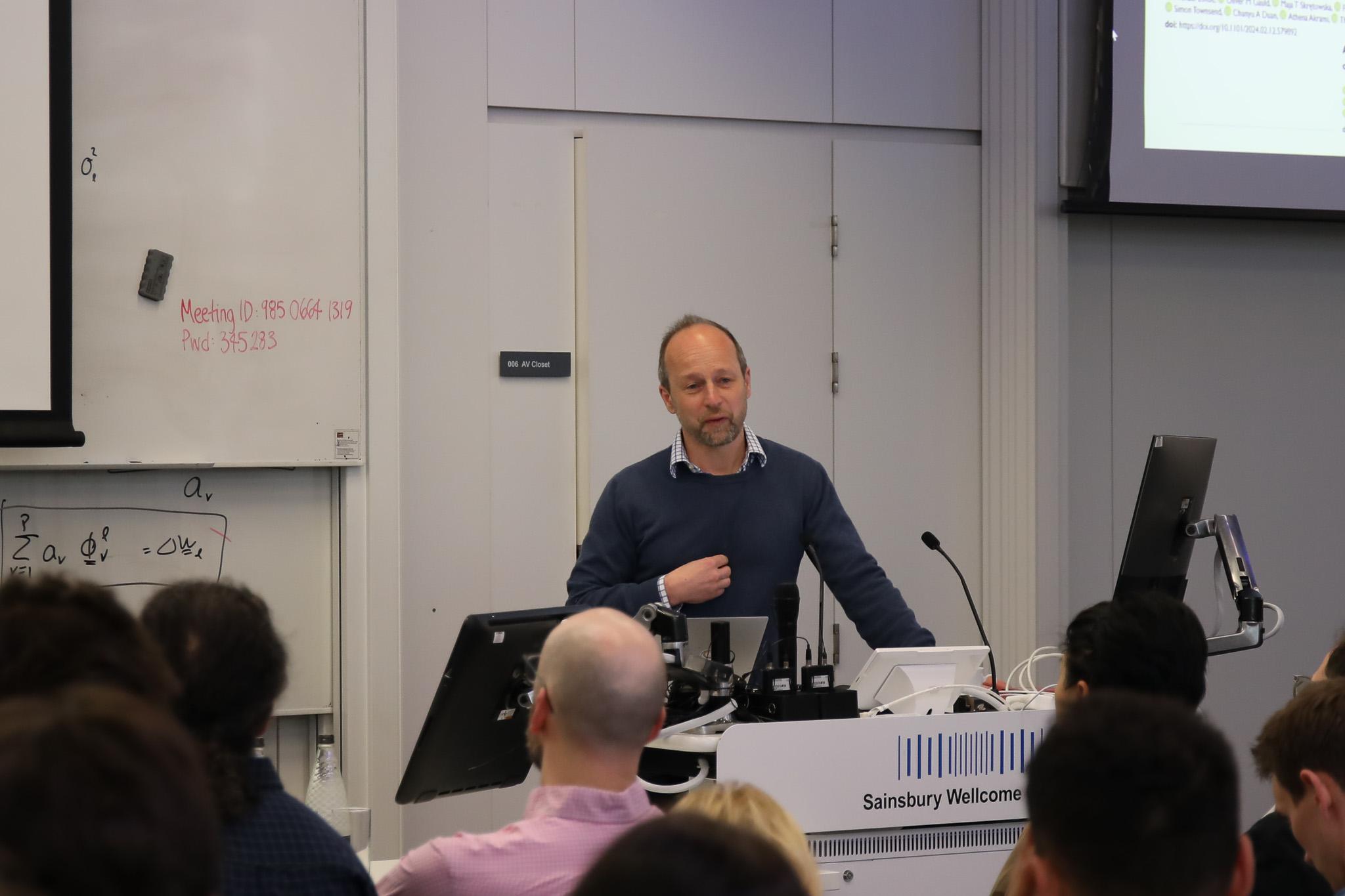
Professor Tom Mrsic-Flogel, SWC / Gatsby Unit Internal Sympoisum
Professor Tim Behrens, Group Leader at SWC and the University of Oxford, opened the research talks. He presented an ambitious account of how the brain constructs and uses world models, not just in physical environments but also in abstract conceptual spaces. The work pushes at one of the most important questions in systems neuroscience: how does the brain generalise knowledge, including abstract knowledge, across contexts? His answer, built on work linking the hippocampal formation to frontal cortex, suggests the brain may combine and reuse cognitive ‘building blocks’ in different ways to solve new problems.
Next on stage was Alice Kotchev, PhD student in Sonja Hofer’s lab. Her talk described how the ventrolateral geniculate nucleus (vLGN), a small inhibitory region, acts as a gate between caution and courage. Using optogenetic stimulation in mice, she showed that activating this region could shift animals from fearful avoidance to exploratory behaviour, even in the context of elevated anxiety. The vLGN sits at a convergence point for inputs from the retrosplenial cortex and the ventromedial hypothalamus, with integration of competing signals from these areas determining whether a mouse stays safe or ventures out.
Valentina Njaradi, a PhD student in Peter Latham and Andrew Saxe’s groups in the Gatsby Unit, then offered a computational counterpart. She presented an analytical model of how the brain builds and uses schemas: compressed statistical representations of the world that allow fast learning in new situations. Her work demonstrates that schemas optimised for generalisation produce exactly the memory distortions humans are all too familiar with, including the tendency to remember things we never actually encountered.
After lunch, Dimitri Kullmann, Professor of Neurology at the Institute of Neurology, UCL and affiliate at SWC discussed progress towards developing new epilepsy treatments. Epilepsy affects around 600,000 people in the UK and, despite optimal treatment, 30% of people with the condition have uncontrolled seizures. His group is developing new gene therapy strategies, and aims to treat the condition where current treatments have failed. He described a suite of approaches, including a potassium channel overexpression and a glutamate-gated chloride channel that converts excitatory signals into inhibition. The first human trials are due to start in 2027.
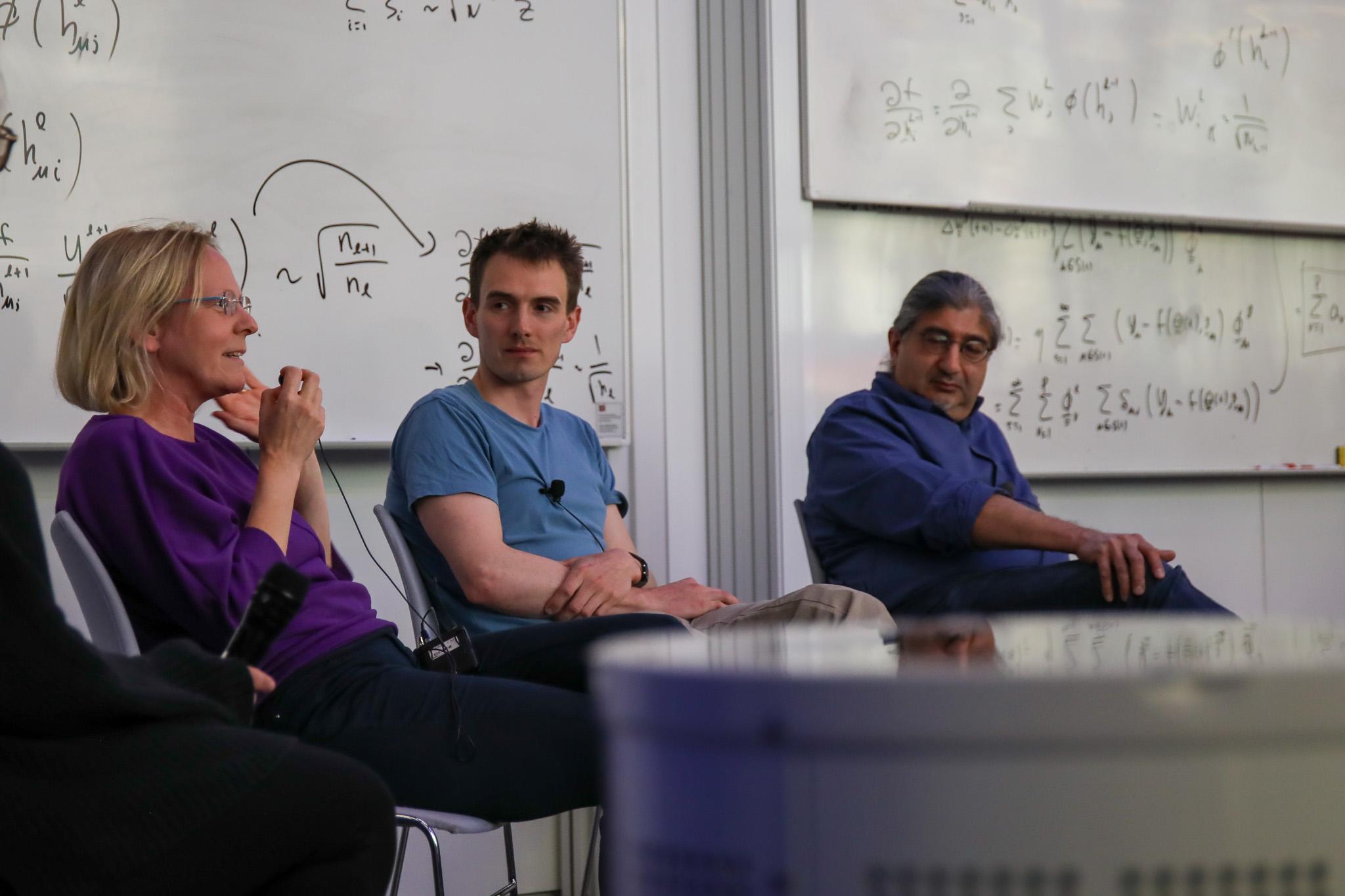
Professor Sonja Hofer, Dr Kris Jensen and Professor Maneesh Sahani.
Dr Agostina Palmigiano, a Group Leader at the Gatsby Unit, followed. She presented theoretical work seeking to understand the consequences of optogenetically perturbing neural circuits, and why the results are often counterintuitive. Her research explains a phenomenon called co-tuned suppression, where stimulating neurons with similar preferences produces less activity, not more. The culprit, the model predicts, is a specific class of inhibitory interneurons, somatostatin cells, whose responses amplify suppression in a nonlinear way. Experimentalists at SWC will be testing the theory in the brain.
Dr Tim Sit, Research Fellow at SWC in the Duan lab, presented next. His work seeks to understand strategic behaviour and decision-making in competitive situations. In collaboration with Joanna Aloor in the Duan lab, he studies this using matching pennies, a game where players need to become unpredictable to avoid being exploited by their opponent. Comparing gameplay between species - mice, monkeys, and humans – shows that all players adapt and become random under competitive pressure, but they get there differently. Mice start with simple biases and slowly learn to randomise. Humans start with more sophisticated strategies already in place. The most recent work pits mice against mice, and humans against humans, to study how strategy shifts when the opponent is no longer a fixed algorithm but an adaptive agent with its own history.
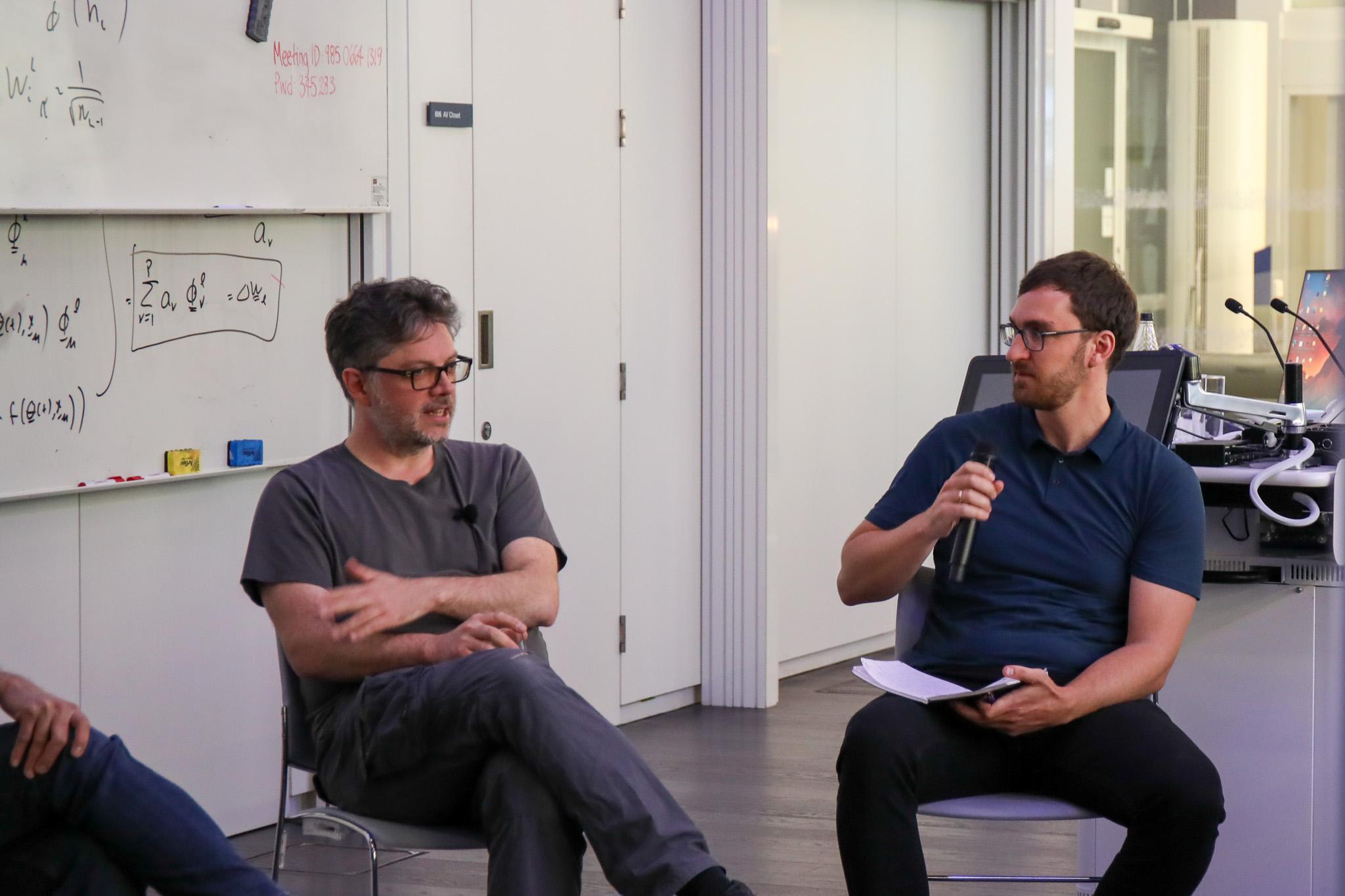
Dr Dan Goodman and Dr Adrian Roggenbach
The day closed with Dr Dan Goodman, Associate Professor at Imperial College London. He introduced the panel discussion - will we ever understand the whole brain? His answer was yes, but contingent on the field addressing four structural problems: studying animals performing tasks that are too easy, concepts that do not scale, ever-shifting foundations, and a theory-experiment connection that, in many cases, is not deep enough. The panel, including Professor Sonja Hofer, Professor Maneesh Sahani, Dr Kris Jensen, and Dr Dan Goodman, discussed what understanding even means in this context, and whether current career incentives align with the kind of long-term, collaborative, complex work the questions demand.
There wasn’t a consensus. With the human brain considered by many to be the most complex object in the known universe, perhaps this isn’t a surprise. But ten years into our joint effort of unravelling the mechanisms of intelligent behaviours, SWC and the Gatsby Unit remain at the forefront of understanding the organ that makes us who we are, and a place that takes the difficulty seriously.