Not just speed: the biomechanics behind every step
14 August 2026
Do you walk, skip, or sprint down a path? Moving from one location to another is a main motor output of the mammalian nervous system, essential for everything from foraging to escape. But how animals choose to move, and when to switch from one gait to another, isn’t well understood.
It was a visit to a horse farm in Iceland that first sparked Dr Zane Mitrevica's interest in gait. There, she learned that as well as the standard walk, trot and canter/gallop, Icelandic horses also have the tölt (ambling gait) and the flying pace - unique movements among horses.
With the horses bred from a genetically tight pool, she reasoned there was a genetic component to their movements (and this has indeed been shown), but she wondered about the neural control, too. The visit set her on a path to investigate gait in mice during her PhD at the Sainsbury Wellcome Centre. Her findings, now published in iScience, shed light on the relationships between gait, speed and load as an animal moves.
Gait and speed
Previous research has shown that gait is very closely tied to speed – when you want to move quickly, you use a different gait than when you want to move slowly, trading off speed and effort – but this relationship isn’t fixed. Animals will switch between gaits not only based on the speed they need to go, but on load, posture, and their shape. For example, horses carrying a load on their back switch to gallop at a lower speed than those without. Unlike most other four-legged mammals, giraffes don’t trot. Camels only pace. Mice will trot at most moderate-to-high speeds, at least on a treadmill in the lab.
“Gait is so closely tied to speed that it's really hard to tell them apart when you manipulate something in a nervous system. It seemed like gait, out of all aspects of locomotion, was really underexplored,” says Dr Mitrevica.
Work in dogs suggested that the location of the load – whether it is closer to the fore or hind limbs - has an effect on gait.
“While trying to think of ways to dissociate gait from speed, I drew inspiration from these studies and tried to create a new experimental setup where I could manipulate not just speed, but also the biomechanical distribution of load that mice experience,” she says.
The new set-up involved placing mice on a non-motorised treadmill and tracking how hunched the animal’s posture was at any given time.
“These experiments allowed me to manipulate both load distribution along the anterior-posterior body axis and the total load the mice experienced. This meant I could separate between effects of load distribution and the effects of total load,” she explains.
She used DeepLabCut, an open-source Python toolbox for markerless pose estimation, to track the movement and posture of the mice. Dr Mitrevica hopes that in the future, this paradigm will help researchers understand the neural circuits associated with both gait and speed.
Switching between gaits
Her studies uncovered that the shifts between interlimb coordination patterns – between trot and canter, for example - don't always fall within clean gait categories. Instead, the changes in limb movements were more continuous, and so Dr Mitrevica studied the phases of different limb pairs separately.
She saw that when mice carry more of their weight on their back legs, the two legs on the same side of their body, on average, start moving more in sync with each other, rather than swinging in the usual alternating pattern. And critically, this happened regardless of how fast the mouse is moving. “It was weirdly consistent across speeds. I was quite surprised to see that,” she adds.
“It’s an interesting finding because in other experiments with dogs, where the position of the load was changed, they saw the opposite effect. So when their forelimbs were more loaded, their homolateral limbs were more synchronised,” Dr Mitrevica said. She speculates that this could be linked to where the animal's natural centre of support is - closer to the forelimbs for dogs, and slightly closer to the hind limbs for mice.
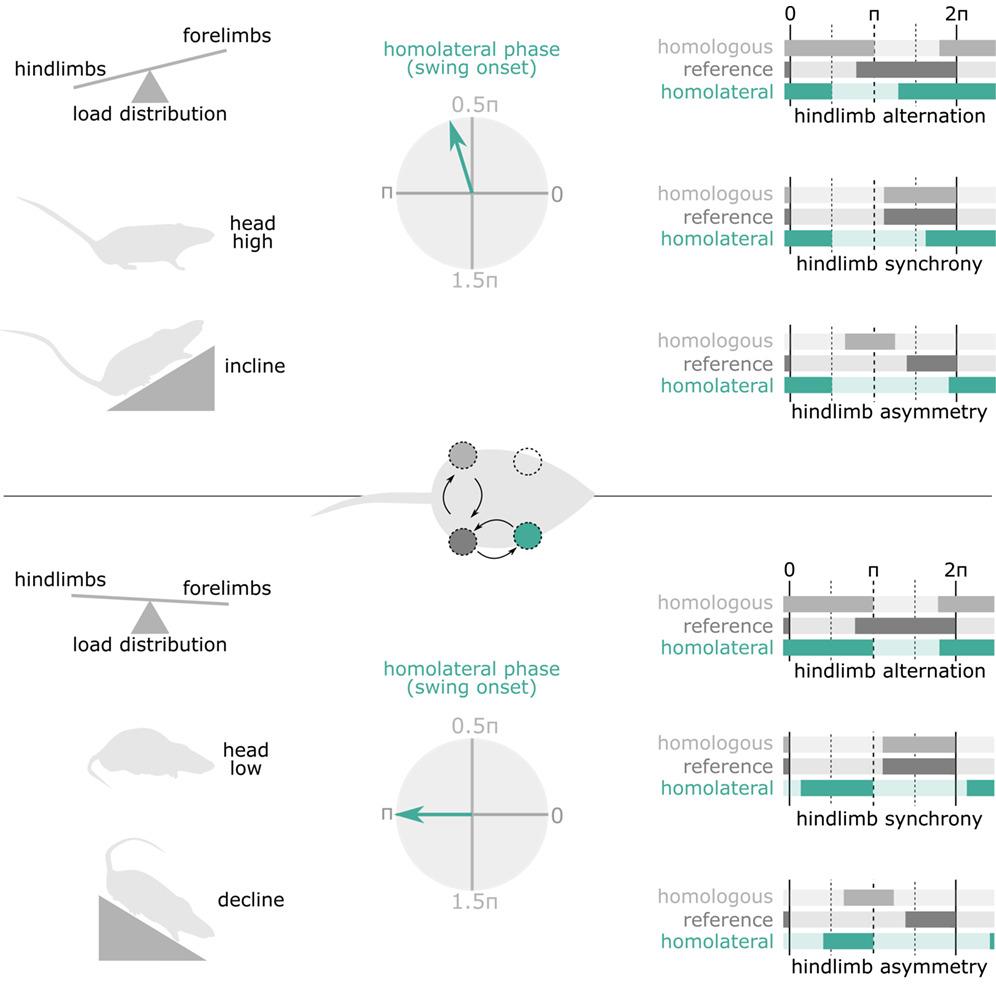
Summary of the work showing the changes in limb movements.
“We’ve shown that biomechanics matter a lot to gait. And it's important to acknowledge that in a way that I think it hasn't been previously in mouse research,” she says.
We might not think about our gait often, but it is a behaviour that affects speed, stability, efficiency and survival – and one we are only just starting to understand.
“Recent work by researchers at the Max Delbrück Center for Molecular Medicine aimed to simulate the moon’s gravity for mice here on Earth. It turns out that mice skip, just like astronauts do. Gait is super cool to study.”
Find out more
- Professor Tiago Branco’s profile, who supported Dr Mitrevica during her PhD and publication of the work.
- Read the paper in iScience.
- Find out about the SWC PhD programme.
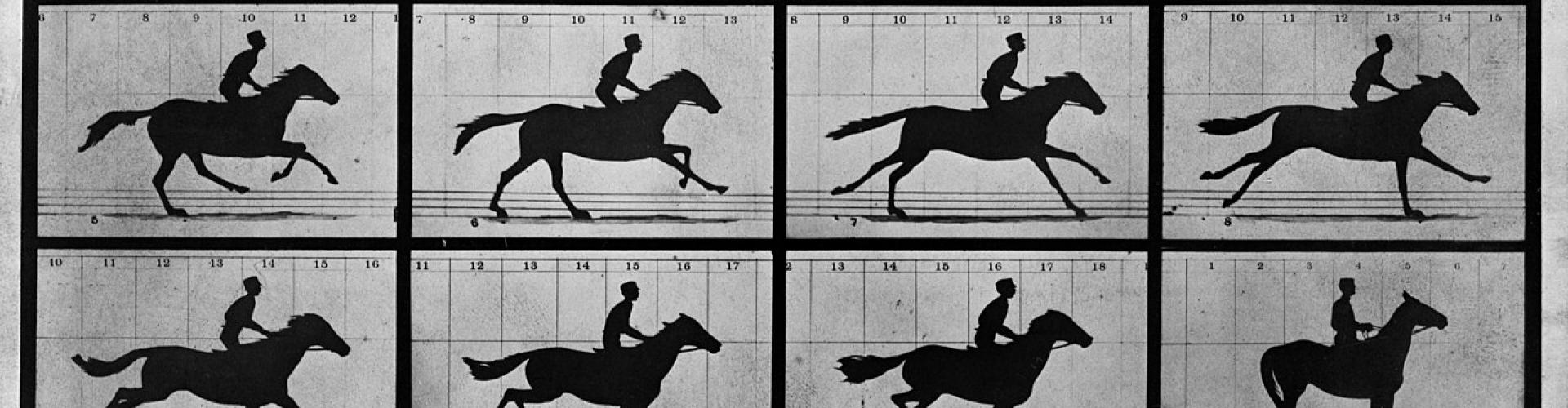
- Banner image: ‘The Horse in Motion’ by Eadweard Muybridge, 1878, via Wikimedia Commons.