
Primed to fire: the hair-trigger neurons that drive escape
6 July 2026
Escape is an ancient behaviour, evolved over millennia across the animal kingdom. To survive, an animal must know when to run away from looming danger – whether that’s a falling branch or a hunting predator. Escape needs to be specific, so resources aren’t wasted on sprinting from innocuous rustling leaves or the shadows of clouds, and it needs to be fast.
Neuroscientists at the SWC are studying precisely how the brain achieves this feat, and new research from Professor Tiago Branco’s lab, led by Dr Yaara Lefler, completes a key piece of the puzzle. They have shown that neurons in the mouse brain’s escape command centre, the dorsal periaqueductal grey (dPAG), are exquisitely poised to respond to a tiny amount of input. When they receive it, they fire. And when enough cells in the dPAG fire, an escape is triggered.
Their finding builds on the lab’s previous work, which showed that escape signals are filtered in the medial superior colliculus (mSC) – a midbrain area that receives input from sensory organs. Cells there act as a gateway and remove the irrelevant ‘noise’ of everyday life. They encode the intensity or importance of a threat, and send those signals to the dPAG1. Recently, the team found that the timing of the signals into the dPAG matters, with rapid bursts of firing triggering an escape2.
Their new work, now published as a preprint, completes the other side of the story – how the signals cause a rapid and reliable response.
A unique method
Their findings rely on a unique method: a system that allows for whole-cell recordings in animals as they escape.
The setup includes a lightweight platform, hovering on an air table, for a mouse to investigate, with open areas and a shelter. Animals explored the platform in similar patterns to freely moving mice in larger arenas, and threatening cues caused them to run to the shelter. The setup enables stable, whole-cell patch-clamp recordings, uncovering the electrical properties of cells as a mouse makes an escape.
“There was a lot of optimisation to get this right,” says Professor Branco. “It was technically demanding. Yaara’s work has allowed us to see synaptic inputs in the dPAG in behaving animals.”
The whole-cell recordings showed that, as expected, dPAG cells are quiet and don’t fire while a mouse is exploring and there are no threats. However, they do fire when it escapes. Analyses revealed that the cells have an extraordinarily high level of built-in excitability. It only takes a tiny amount of input to make them fire - thousands of times less than cells in other areas of the brain need.
“These cells exist in a state that can be approximated as on or off. As soon as they receive enough input, they turn on. When they turn on, it's enough to generate the activity necessary to implement escape. The system is super electrically excitable - that's why it works. It's quiet because there's a filter upstream for selecting input. But when enough gets through, the way these cells solve the reliability problem is they immediately go boom! It’s very different from most areas of the brain,” says Professor Branco.
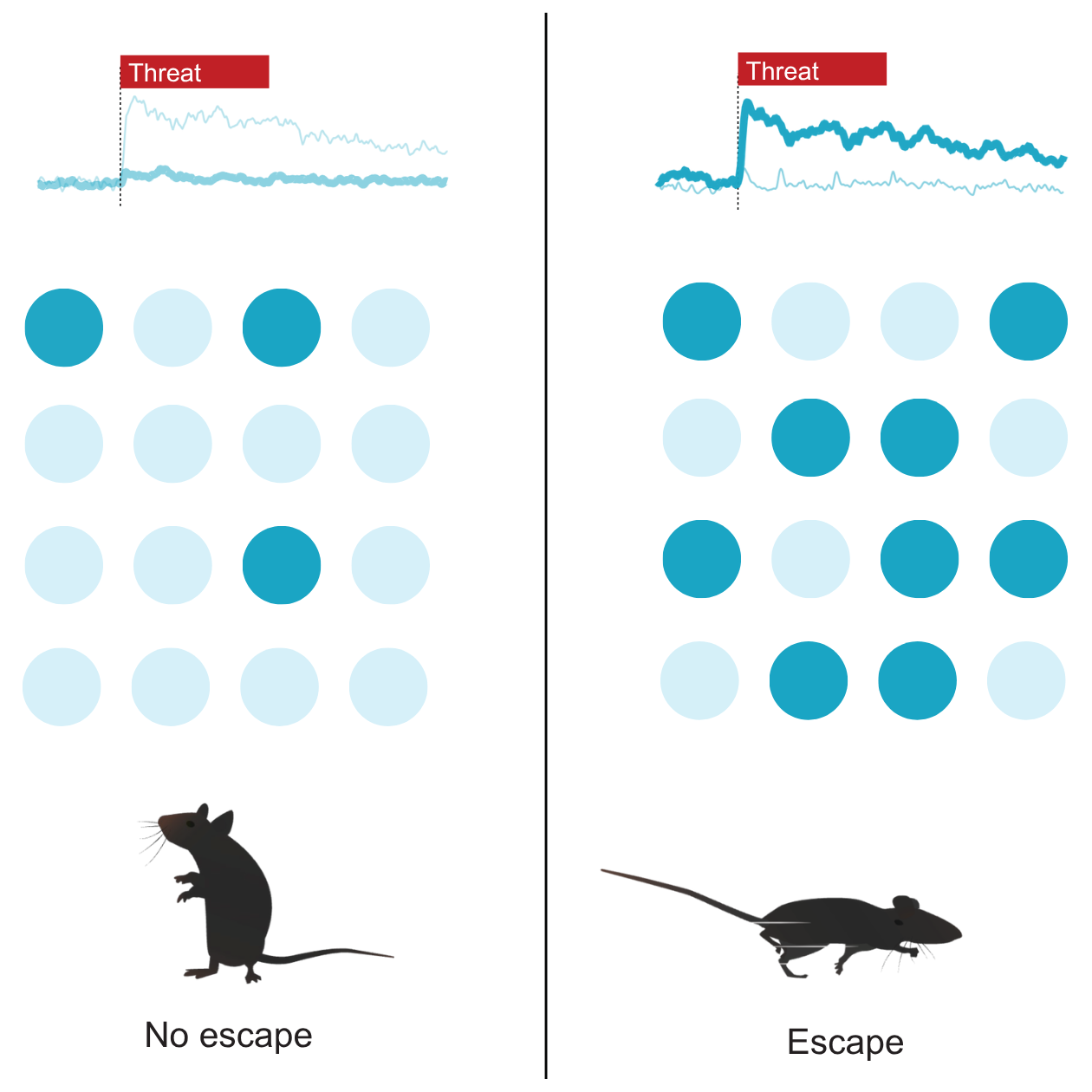
The team made another surprising observation during the whole-cell recordings: when a mouse was confronted with a threat, some dPAG cells fired whether or not the animal decided to flee. “It took us a while to make sense of it,” Branco adds.
A clue came from finding that the probability that a cell fired was much higher when the mouse escaped. To probe this further, the team turned to Neuropixel probes, allowing them to study hundreds of neurons at once while an animal is behaving freely.
They found that what determined the decision to run was not whether a single cell fired, or how strongly, but how many cells fired.
The type and time of a threat
In the last sets of experiments, the team found that the escape response was the same, no matter if the threat came in the form of a sound or was visual. This suggests that unlike cells in the SC, which encode the identity of a threat, dPAG neurons discard that information. They convert diverse threat representations into a uniform escape command.
The threat signals arriving into the dPAG are not only diverse in identity, they are also irregular. The researchers show that the high excitability of the dPAG cells means they can convert this unpredictable stream of signals into a stable, sustained electrical response, providing the continuous drive needed to keep running.
The threshold for escape
The question in their sights now is how many cells need to fire to trigger an escape? How is that threshold set?
They hypothesise that the threshold can be very quickly adjusted, depending on the environment an animal is in, or its internal state. It is likely to be set at a level that affects the whole system – it could be influenced by hunger, for example.
“Depending on the context, or with experience, there are going to be mechanisms that allow the threshold to move up and down in a dynamic way. This is what that gives you the ability to regulate how sensitive you are to threat from one moment to the next,” explains Dr Lefler.
Implications beyond escape
It’s possible that other behaviours linked to the dPAG, like the decision to fight an opponent, could be controlled in the same way, say the researchers.
Determining how the threshold for escape is set could lead to a better understanding of human conditions like PTSD or generalised anxiety disorder, where the dPAG is hyperactivated. In these conditions, the brain perceives a threat when there isn’t one – only the memory or the thought of a threat is present. It’s possible that the threshold for dPAG activation is set too low.
“It is only by deeply understanding the whole system, the biophysics of molecules and ion channels in neurons, that we will get to the point of translating that knowledge to human conditions,” says Branco, “that's why it's important to study the system at this level of resolution.”
Find out more
1. A synaptic threshold mechanism for computing escape decisions
2. Presynaptic temporal dynamics flexibly set input weights in the mouse escape circuit