
New BBSRC funding to build a foundation AI model that can learn the 'language' of mouse behaviour
16 October 2026
Dr Dario Campagner and Professor Tiago Branco at the Sainsbury Wellcome Centre (SWC) have been granted new BBSRC funding. The award will support the team to create an open-source AI model that recognises and describes patterns in animal behaviour with unprecedented detail. The aim is to better characterise behavioural traits, detect changes over time, compare results across studies, species and mouse models for diseases, and link behaviour to brain activity. The model is expected to benefit neuroscience, preclinical and ecological research.
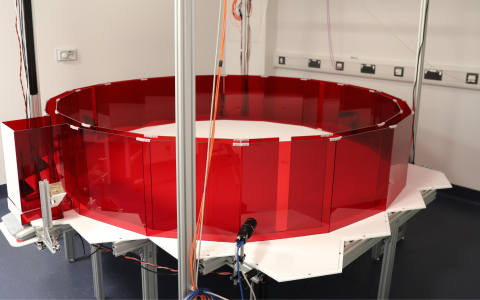
The brain has evolved to control all aspects of behaviour, from minute movements that take milliseconds to actions that combine into routines over days, weeks or months. These hierarchical structures and long timescales are not typically captured in neuroscience experiments, though things are changing. Advancing capabilities mean that data are now being produced on an unprecedented scale. Long-term neural recordings and video-based body tracking of natural behaviours are becoming routinely collected, thanks to platforms like Aeon.
Quantifying the rich nature of natural behaviour over long time scales is the key challenge that the team will address with this new funding. They will develop a foundation model that learns a behavioural ‘language’ for mice, describing their behaviour in a consistent, standardised way. Like the large language models behind modern chatbots, a foundation model is trained once on very diverse data, then adapted for many different uses.
“Foundation models are extremely powerful because they can learn complex structure from very large and complex datasets, but their success depends on having enough high-quality training data,” said Dr Dario Campagner, Aeon Group Leader and Senior Research Fellow at SWC. “Thanks to the Aeon platform, we have now collected hundreds of billions of frames of mouse behaviour across a wide range of natural and learned behaviours, all recorded in a consistent format. This puts us in a unique position to train a general model of mouse behaviour and, importantly, to make it openly available so that researchers can adapt it to their own experiments and scientific questions.”
A second tool, an interpretability framework, will turn what the model has learned into a clear structure that links split-second movements to longer routines unfolding over minutes to days. The goal is a model that works across research settings and can be adapted to new scientific questions.
“We are very grateful for this funding, which will open up ways of quantifying animal behaviour that have so far been out of reach. In the longer term, richer and more precise behavioural measurements could improve how animal models are used to develop treatments for complex conditions such as psychiatric disorders, where symptoms are multidimensional and may be better reflected in detailed patterns of behaviour."
"A big thank you goes to all the members of the Aeon and Branco groups, and in particular to Anaya Pouget and Dr Jacob Bakermans, whose contribution was central to shaping this grant,” said Dr Campagner.
The team will use the new tools to reveal how behaviour is reorganised by disease-relevant conditions such as chronic stress, how animals adapt to rapid human-induced environmental changes, and how evolution has shaped behavioural strategies suited to different ecological niches across mouse species.
The project will deliver a website and open-source software suite including the foundation model, code for model training and fine-tuning, the interpretability framework, plus extended tutorials and documentation.
Find out more
- BBSRC