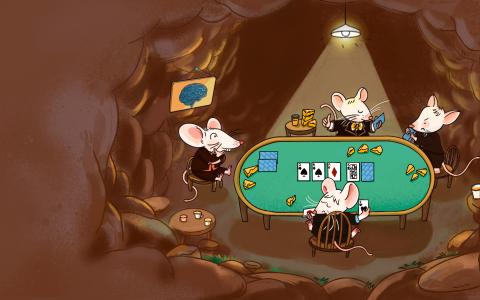
Keeping your opponent guessing: what mice reveal about strategic choice and adaptive unpredictability
New research from the Duan Lab, published as two preprints, shows that mice trained to play a competitive game against an exploitative computer learned to keep their opponent guessing. When a choice was unpredictable, reward signals in the cortex were still present but no longer tied to the next choice. While dopamine tracked reward outcomes to guide learning, norepinephrine signals reflected longer timescale information to shape broader strategy in multi-agent decision contexts.