
Abstract
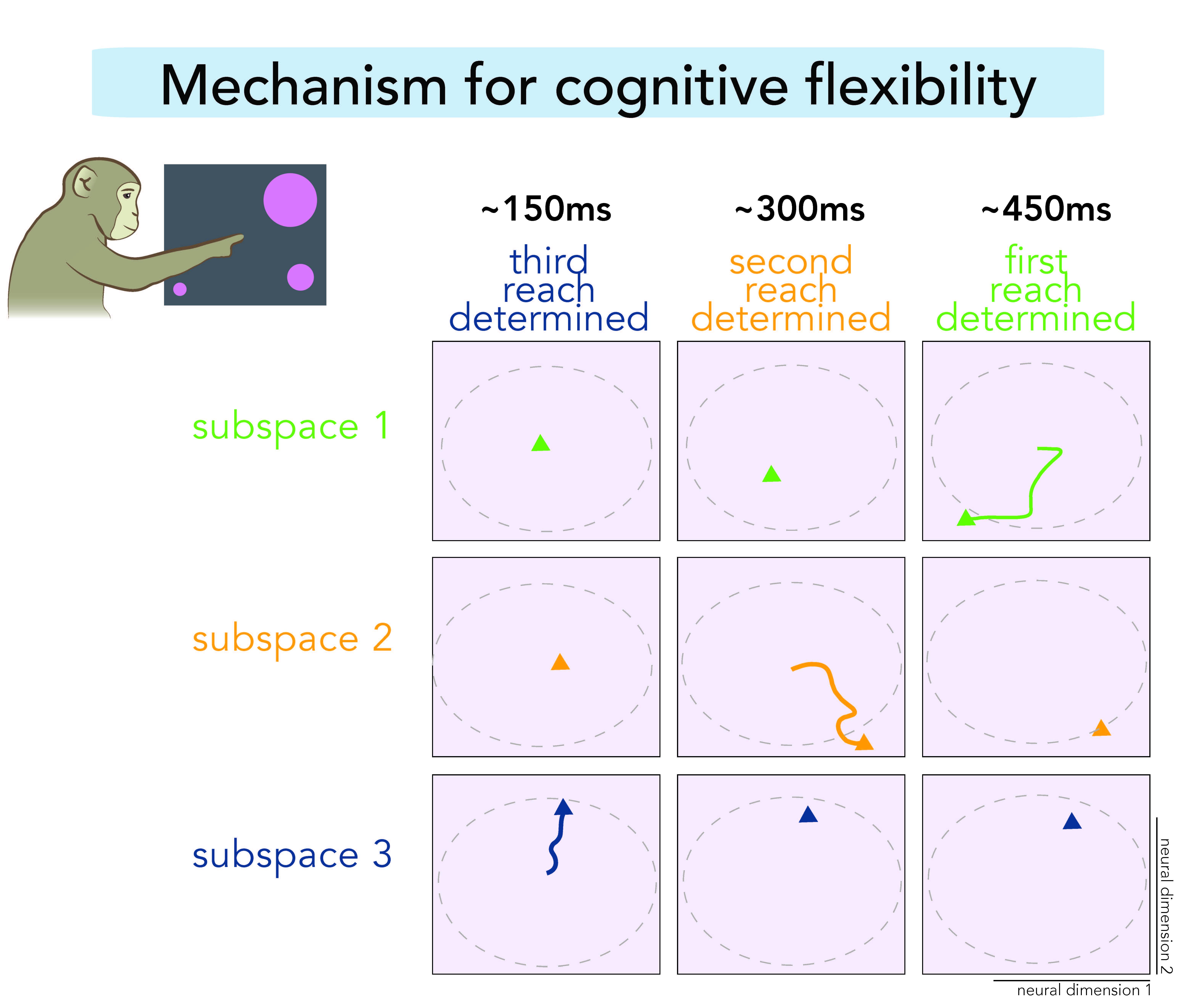
Primates can solve novel problems through logical and stepwise reasoning. No two real-world situations are the same, and how one ‘figures out’ a solution may be similarly variable. Studying reasoning has thus been challenging. How should one investigate the neural basis of internal events whose timing and nature are uncertain, and are unlikely to ever unfold the same way twice? To meet this challenge, we used large-scale Neuropixels-probe recordings, and a novel reasoning task where monkeys apply abstract knowledge to determine the correct ordering of stimuli on the screen. Our recording system enabled us to measure 1000+ single neurons simultaneously both within a single brain region and across multiple distinct regions. Neural activity in lateral prefrontal cortex (but not in other areas) reflected the ‘figuring out’ of a solution. Population analyses of these large-scale recordings allowed us to observe each distinct internal step of the problem-solving process. As one might expect of any intelligent behavior, the set of internal steps, and their timing, were different on every individual trial, and completely under the monkey’s control. For example, the monkey sometimes figured out the last element first and worked backwards. On another trial they used a different approach. Critically, we could interpret neural events on each individual trial, much like a psychologist can interpret behavior on each individual trial. The same neural strategy can unfold differently on different trials yet still solve the problem at hand successfully. Taken together, this research has revealed a computational mechanism for cognitive flexibility, i.e., the process by which a circuit is able to vary the order, the timing, and the strategy by which to make multi-step decisions.
Biography
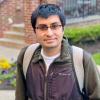
Saurabh Vyas completed undergraduate training in Biomedical Engineering and Electrical Engineering at Johns Hopkins University in 2012. While working on his MSE in Biomedical Engineering, Saurabh was a research engineer at the Applied Physics Laboratory. Saurabh completed his PhD in Bioengineering at Stanford University in 2020, where he was advised by Prof. Krishna Shenoy. His research was recognized with a NSF Graduate Research Fellowship, and a NIH NINDS NRSA (F31) fellowship. In 2021, Saurabh's thesis was awarded the Donald B. Lindsley Prize by the Society for Neuroscience, which "recognizes a young neuroscientist's outstanding PhD thesis in the general area of behavioral (i.e., systems) neuroscience." Saurabh completed a postdoctoral fellowship at Columbia University in 2025, where he was co-advised by Profs. Mark Churchland and Michael Shadlen. Saurabh's work was recognized by both an NIH NINDS Ruth L. Kirschstein National Research Service Award (F32), and a K99/R00 Pathway to Independence Award. In January 2026, Saurabh joined the Neuroscience Institute at Carnegie Mellon University, where he leads the Laboratory of General Intelligence and Computation (LOGIC).