

Abstract
Many fundamental behaviours are under homeostatic control. Understanding these feedback systems requires answering at least three questions: (i) How is the controlled variable internally represented? (ii) What output signal drives a corrective action? (iii) How is this signal generated and regulated? We address these questions in the context of sleep homeostasis, using the tractable nervous system of Drosophila.
To identify which physiological features of sleep need are monitored by the brain, we profiled single-cell transcriptomes of neurons projecting to the dorsal fan-shaped body (dFBNs), a major site of sleep regulation. Sleep loss in these neurons triggers a selective upregulation of genes linked to aerobic energy metabolism and a downregulation of genes encoding presynaptic machinery. This dual response provides a first link between cell-intrinsic and network-wide signatures of sleep deprivation, which we explore separately.
This transcriptional reprogramming aligns with organelle-level structural changes, including mitochondrial fission, enhanced mitophagy, and increased mitochondria-ER contacts. Artificially inducing mitochondrial fission reduces both sleep and neuronal excitability, whereas promoting fusion yields opposite effects. We propose that these shape changes reflect a mismatch between ATP demand and electron flux: during sleep deprivation, wake-promoting dopamine inhibits dFBNs, generating an electron surplus through elevated ATP levels. Conversely, activating a light-driven mitochondrial proton pump to bypass the electron transport chain promotes sleep by exacerbating the ATP–electron imbalance. These findings reveal a mitochondria-mediated feedback loop in which electron leak and ATP output bidirectionally regulate neuronal excitability and sleep.
How do dFBNs convey this cell-intrinsic account of sleep need to downstream circuits by means of their population dynamics, and how are these dynamics orchestrated? Our in vivo patch-clamp and calcium imaging recordings reveal that the dFBN ensemble contains highly rhythmic cells whose membrane voltages oscillate at 0.2–2 Hz, alternating between hyperpolarised DOWN and depolarised UP states eliciting bursts of action potentials. These oscillations, whose optogenetic replay promotes sleep, are reminiscent of those in the sleeping brains of mammals but differ in their origin: They rely on direct interhemispheric competition of two mutually-inhibitory half-centres, resulting in the two hemispheres to oscillate in antiphase. Importantly, dFBNs increase their oscillatory power with sleep need. This is orchestrated via an increase in excitability and homeostatic depression of their efferent synapses, as we examine transcriptionally, structurally, functionally, and with a simple computational model.
We place this neuroenergetic feedback mechanism within the broader context of analogous homeostatic systems, including mitochondrial regulation of hunger-promoting hypothalamic neurons and cortical oscillations in sleeping vertebrates.
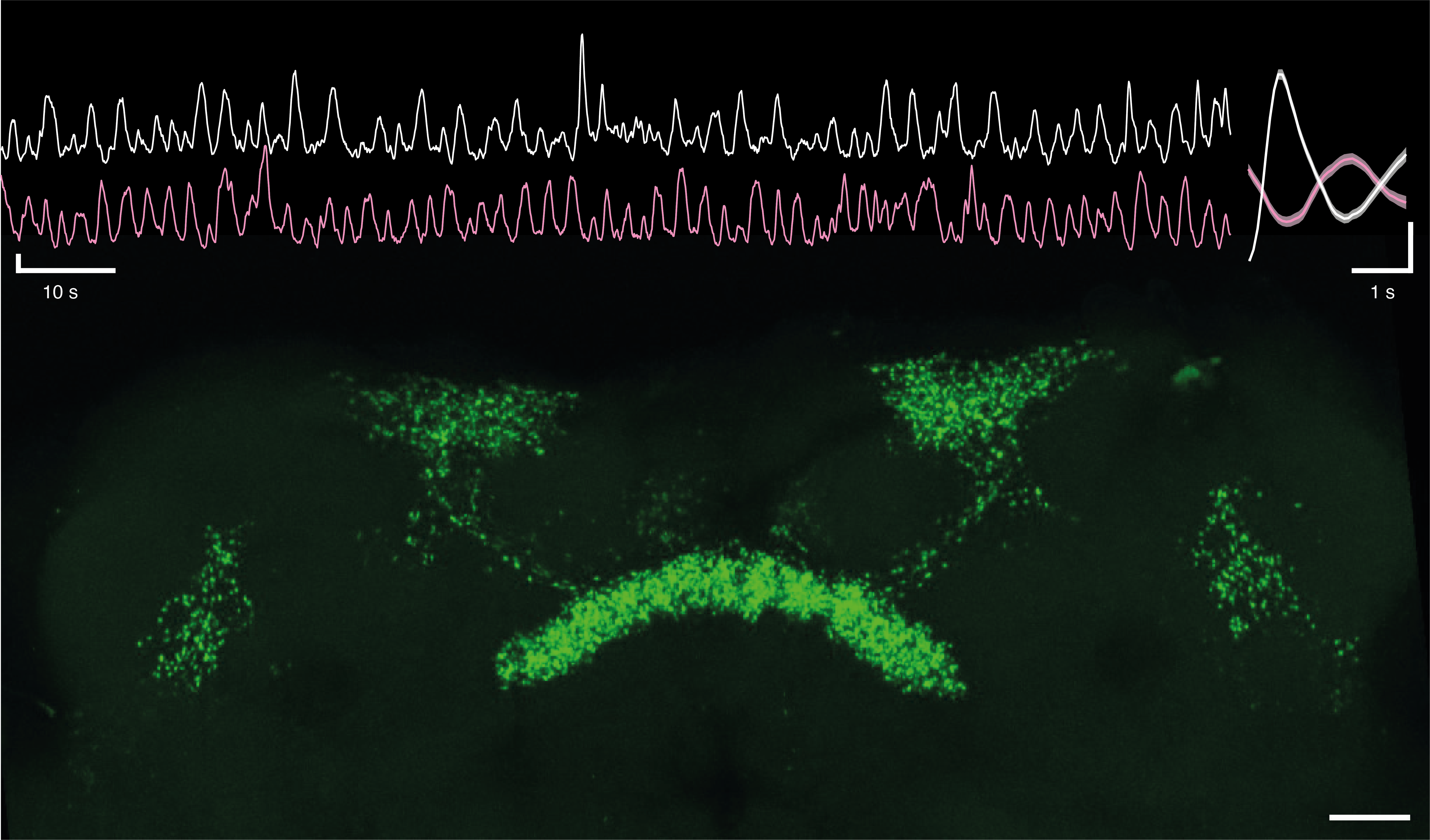
Top left, simultaneous calcium-imaging of dorsal fan-shaped body neurons in both hemispheres. Top right, average GCaMP-transient in one hemisphere (white), and the associated GCaMP-waveform on the contralateral hemisphere (red). Y-axis scale bars: 1 z-score. Bottom, maximum intensity projection of a fly midbrain where dorsal fan-shaped body neurons have their mitochondria labelled with mito-GFP. Scale bar: 20 µm.
Biography
Raffaele is a postdoctoral and Junior Research Fellow at the University of Oxford, in the lab of Gero Miesenböck. He studied molecular and cell biology at Scuola Normale Superiore and University of Pisa, and neuroscience at the University of Oxford, where he obtained an MSc and his PhD.
Raffaele uses a wide range of experimental approaches to investigate the molecular machinery and circuitry network dynamics that encode sleep need, and more broadly is interested in the interplay between neuronal metabolism and activity underlying behaviour.
Peter is currently a postdoc in the lab of Gero Miesenböck at the University of Oxford. He completed a combined M.D.-Ph.D. Program at the Medical University of Vienna, where he used mathematical modelling and electrophysiology to study the kinetic basis of serotonin transport across the cell membrane.
As a postdoc, Peter has combined computational and experimental approaches to understand how neural circuits generate representations that support action selection. He pursues this aim in the context of sleep homeostasis and perceptual decision-making in Drosophila.